Features · What they receive

What lands on the other end.

You see the editor. Your crew and clients see an email from your company, a page that works on a phone, and a PDF they can keep. This is that side, every email and every page, captured from the sandbox exactly as the app sends it — nothing mocked up, nothing tidied.
the crew member’s inbox · Call Sheet — Fireside Chat — Ep. 4
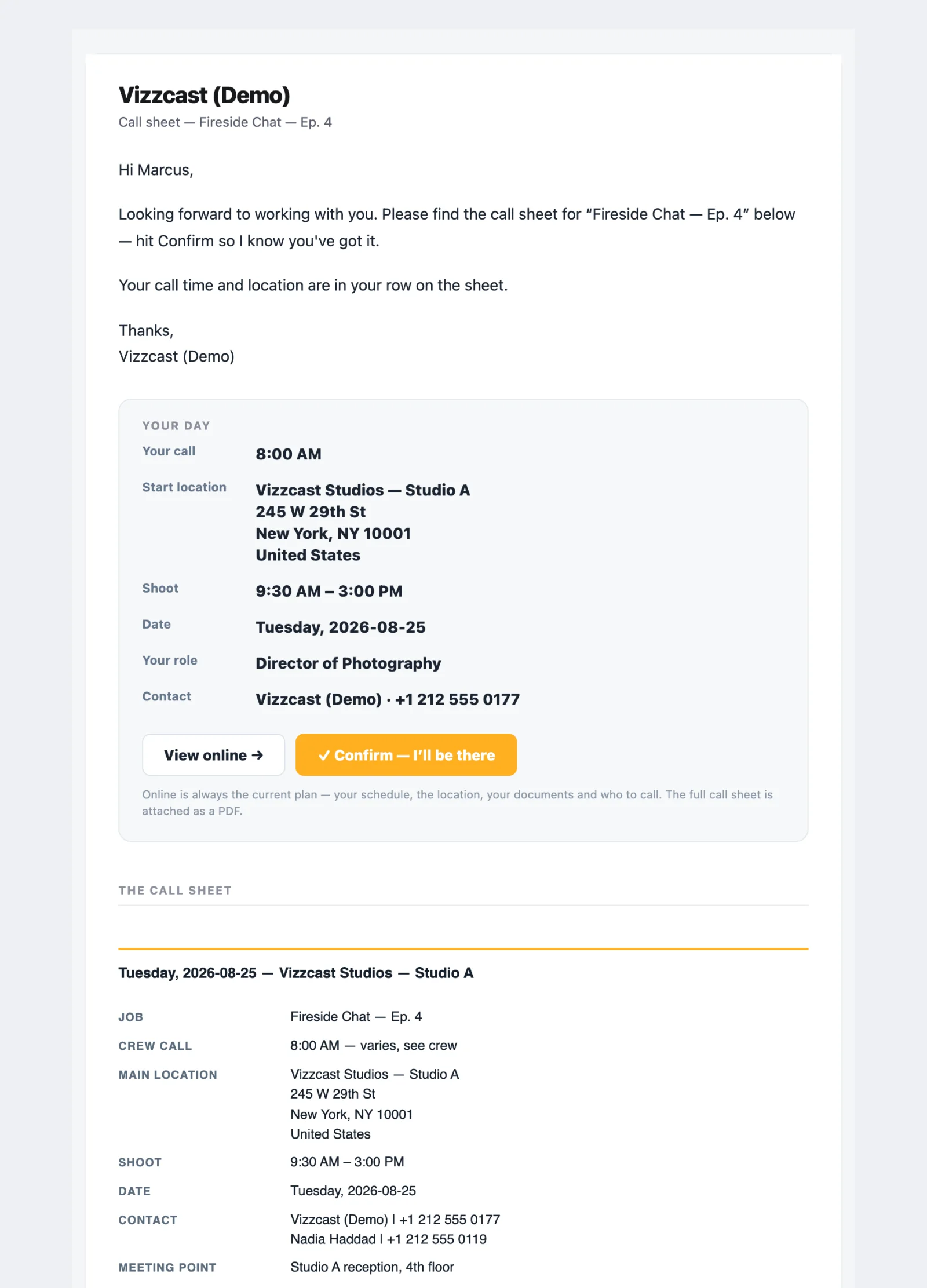
The call sheet email as it lands: the company name, a greeting by first name and the message, then a Your day card with the person's own call time, start location, shoot times, date, role and contact, a View online button and a Confirm — I'll be there button, and the full call sheet beneath
The call sheet email. Their own day is the first thing in it; the whole sheet follows, and the PDF is attached.
00 · FROM KITSLATE ITSELF — the account emails, before any job

Before any of that: the invitation.

Four emails come from KitSlate rather than from a company: the invitation, the note that says a request for access has arrived, the seat invitation when a workspace adds someone, and the one warning that a complimentary plan is about to end. Everything else on this page comes from your company.
One tap, no password to inventAccept the invite and sign up under the same email address. Free to start, no card needed.
The sandbox first, if they likeBoth the invitation and the waitlist note link to a full workspace with a production already in it, with nothing to undo.
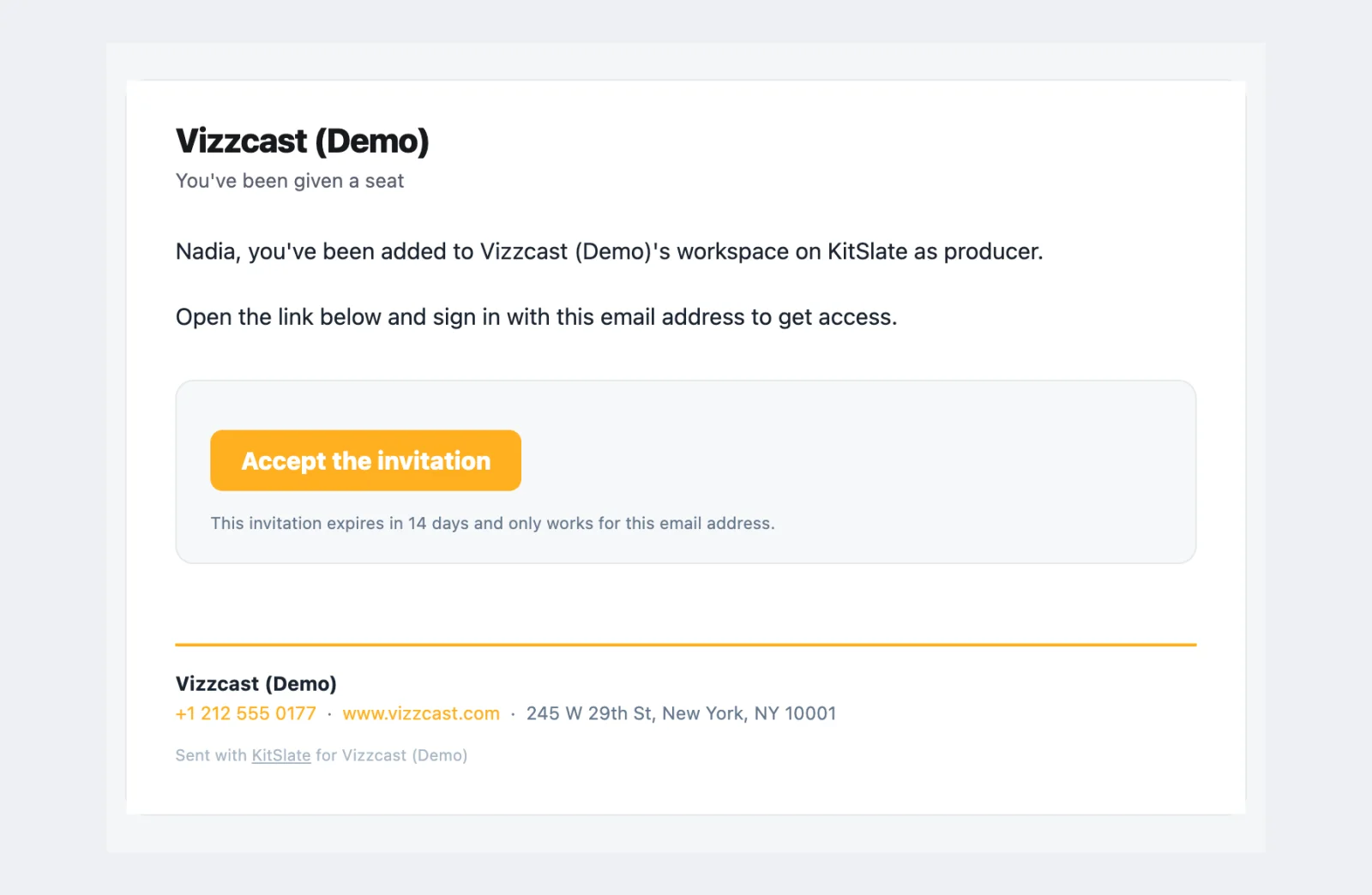
A seat is a real loginA team member gets their own invitation from your company, expiring in 14 days and tied to their email address.
Nothing tracked without saying soThe unsubscribe line is in every one of these, and a recipient who is not interested is never emailed again.
You’re invited to KitSlate
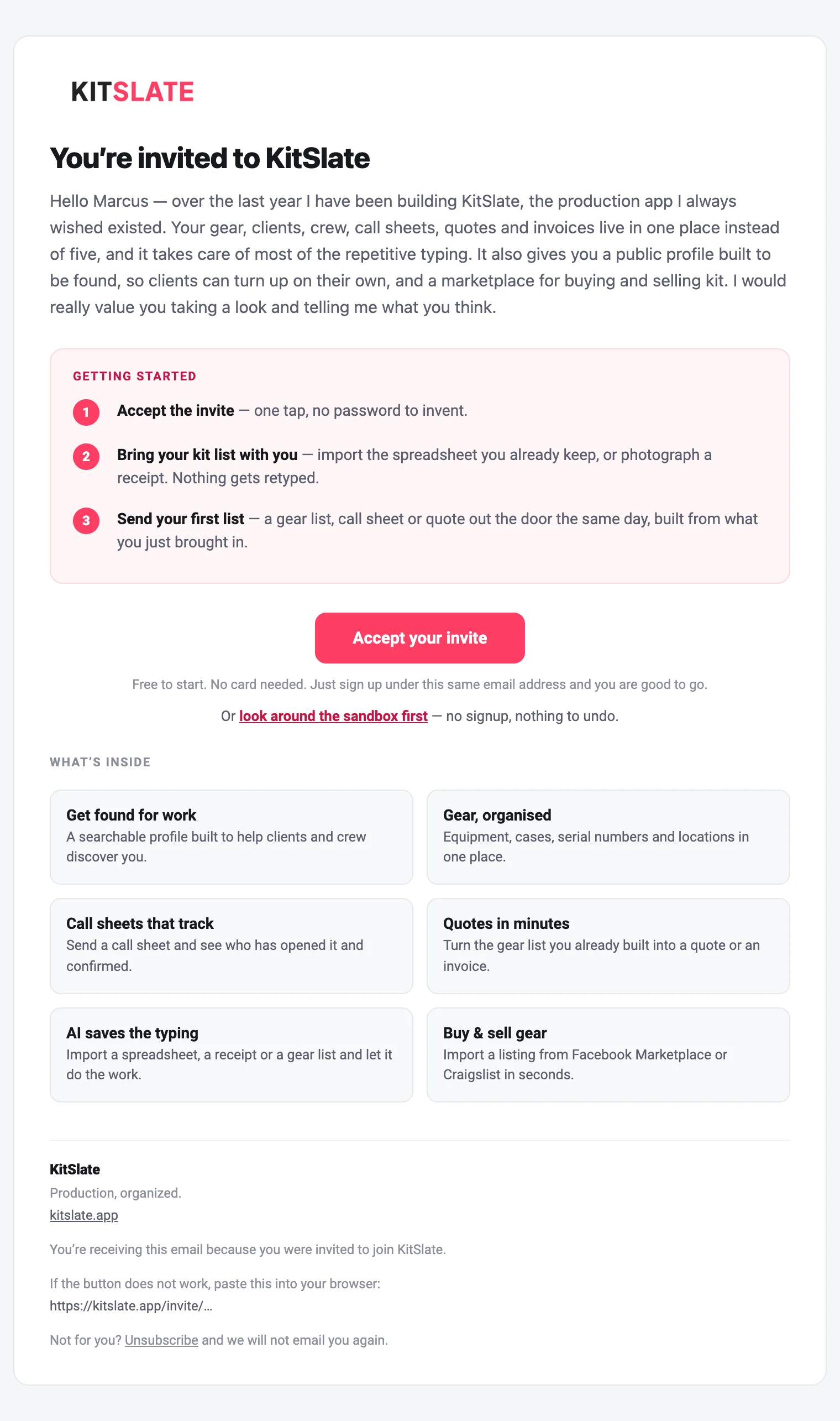
The KitSlate invitation email: the wordmark, You're invited to KitSlate, a personal note, a Getting started box with three numbered steps, an Accept your invite button, a link to look around the sandbox first, six What's inside tiles, and the footer with the unsubscribe line
The invitation. Three steps, one button, and the sandbox for anyone who wants to look first.
We have your KitSlate request
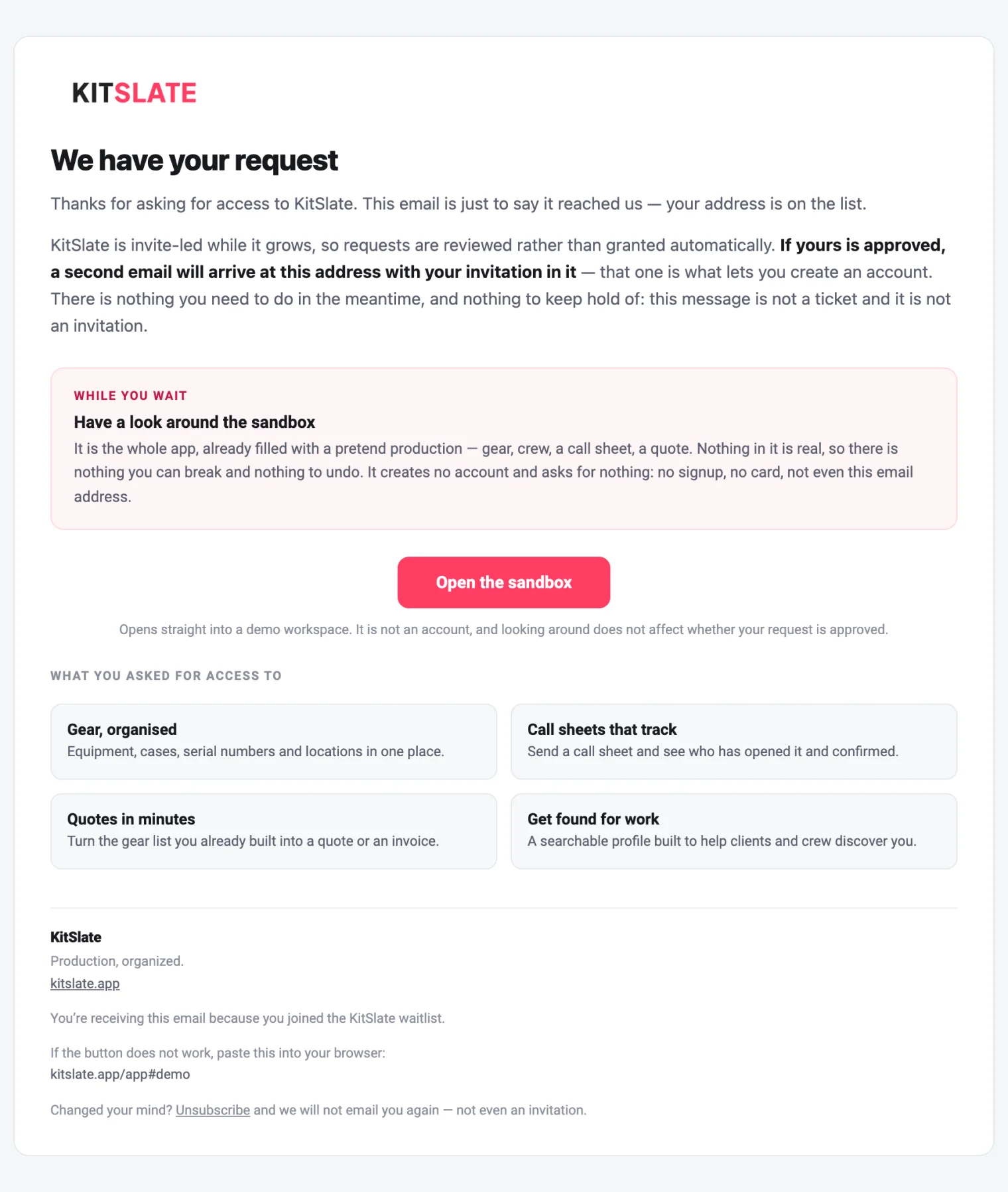
The waitlist email: We have your request, a note that requests are reviewed and a second email brings the invitation, a While you wait box about the sandbox with an Open the sandbox button, four tiles naming what was asked for, and the footer with the unsubscribe line
The note a request for access gets back. It says plainly that it is not a ticket and not an invitation.
Vizzcast (Demo) — you’ve been added to the workspace
The seat invitation from a company: You've been given a seat, a line saying the person has been added to the company's workspace on KitSlate as producer, an Accept the invitation button, and a note that it expires in 14 days and only works for that email address
The seat invitation. From the company, with the role named, expiring in 14 days.
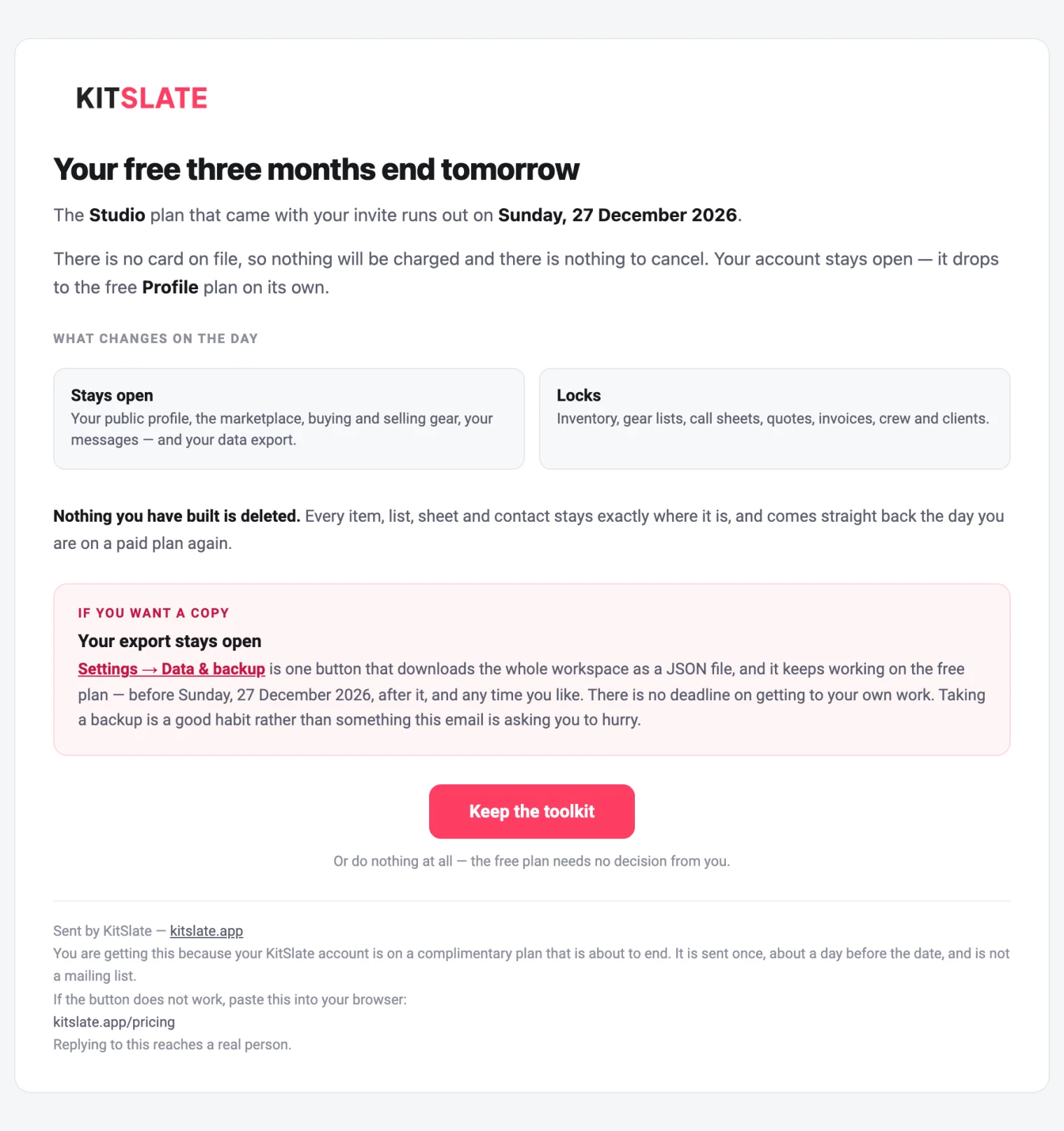
Your free three months of KitSlate end tomorrow
The comp-ending email: Your free three months end tomorrow, the plan and the date, what stays open and what locks, a note that nothing built is deleted, an If you want a copy box about the export, a Keep the toolkit button and a line saying the free plan needs no decision
The only warning a complimentary plan gets: what changes, what stays, and that nothing is deleted.
01 · THE CALL SHEET — one email per person, their own day first

Their call, their location, one tap to confirm.

Nobody is CC’d. Each person gets their own message from your company with their call time and start location at the top, then every section of the sheet. Confirm — I’ll be there opens their online copy and tells you they have it.
From your company, not from KitSlateThe sender is the company on the letterhead, in its colour, and a reply comes straight back to you.
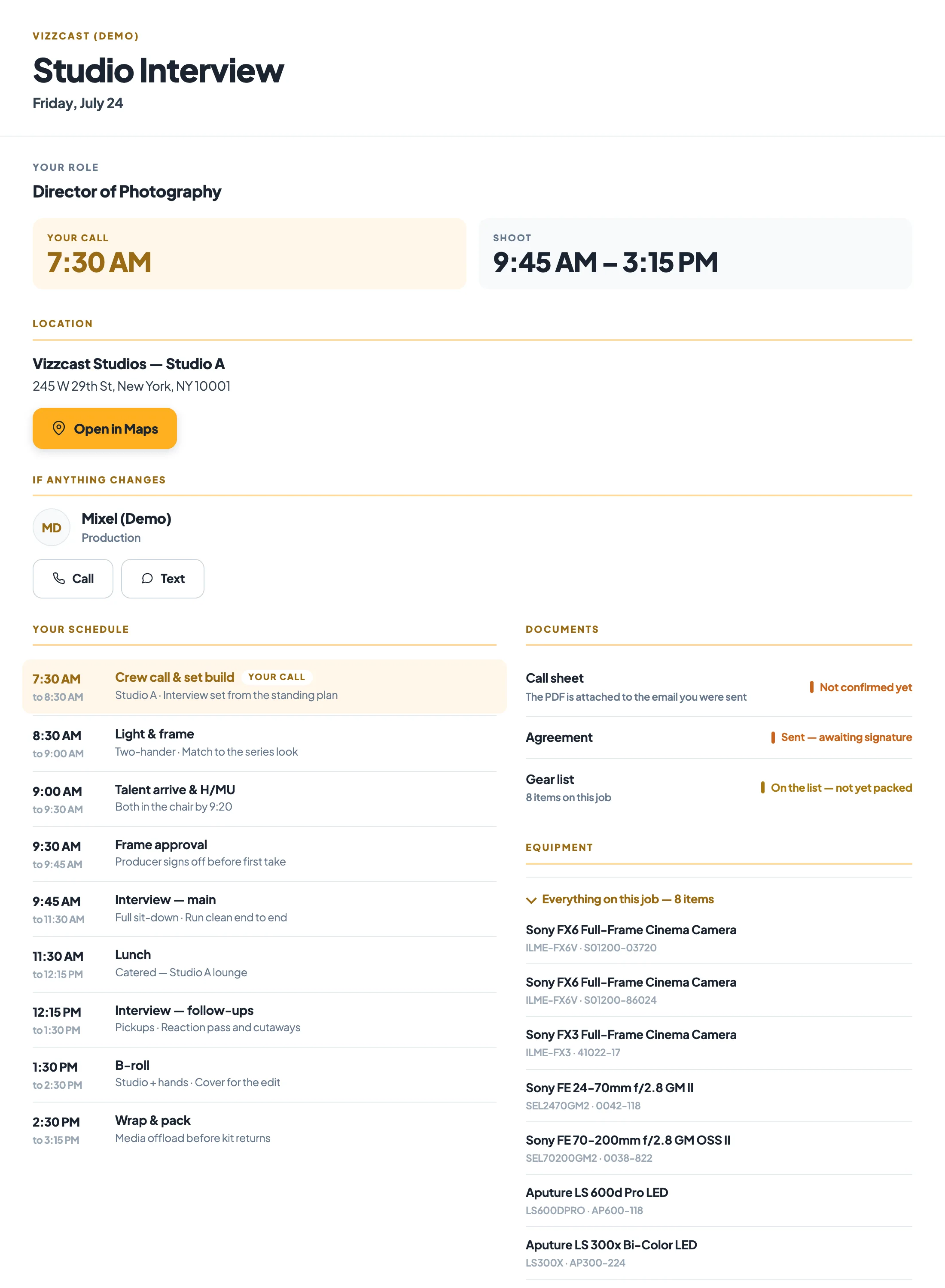
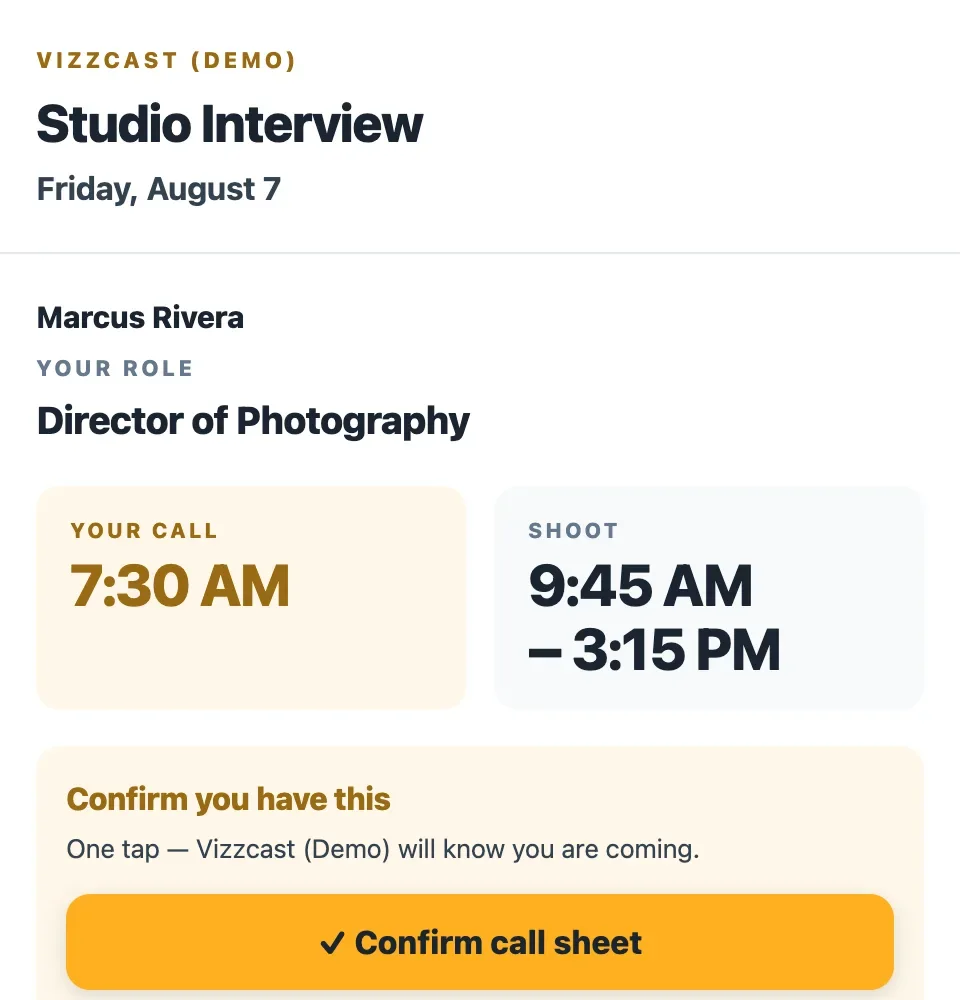
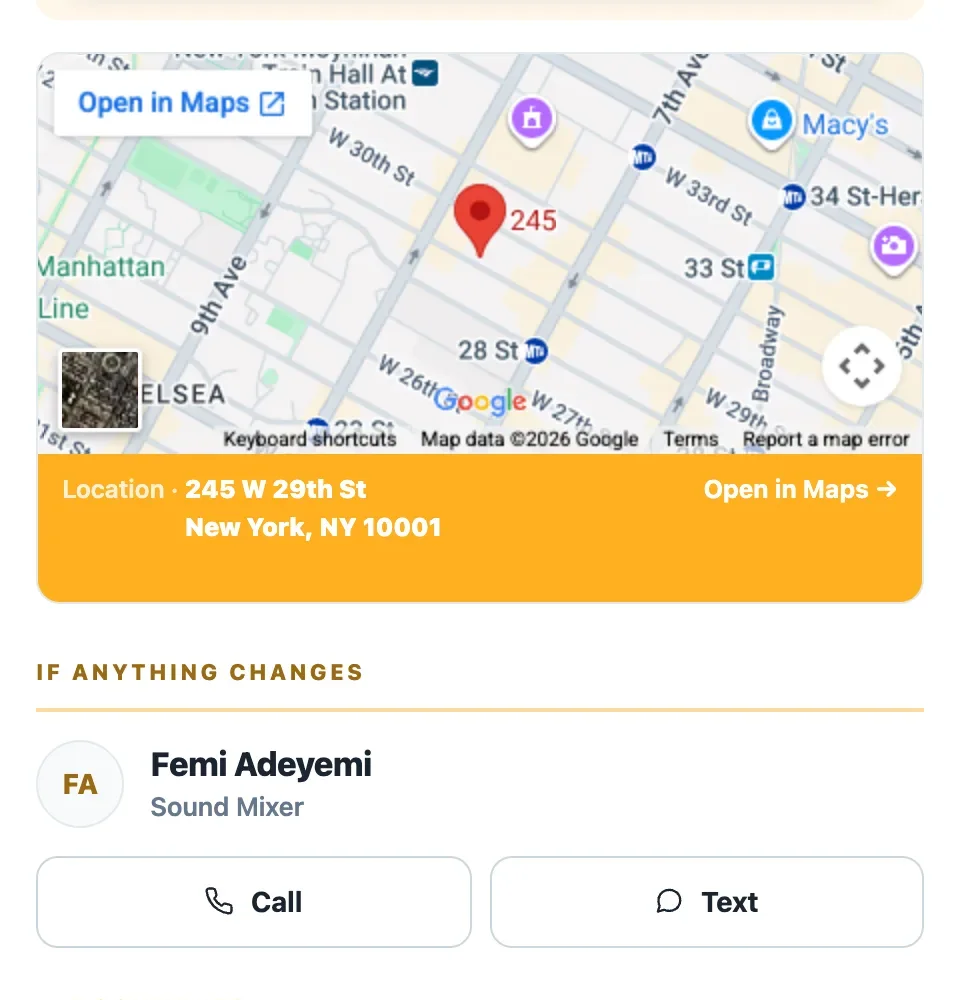
The page works on a phoneTheir role and call, a confirm bar, the map with an Open in Maps button, who to call if anything changes, and their documents — one responsive page, nothing to install.
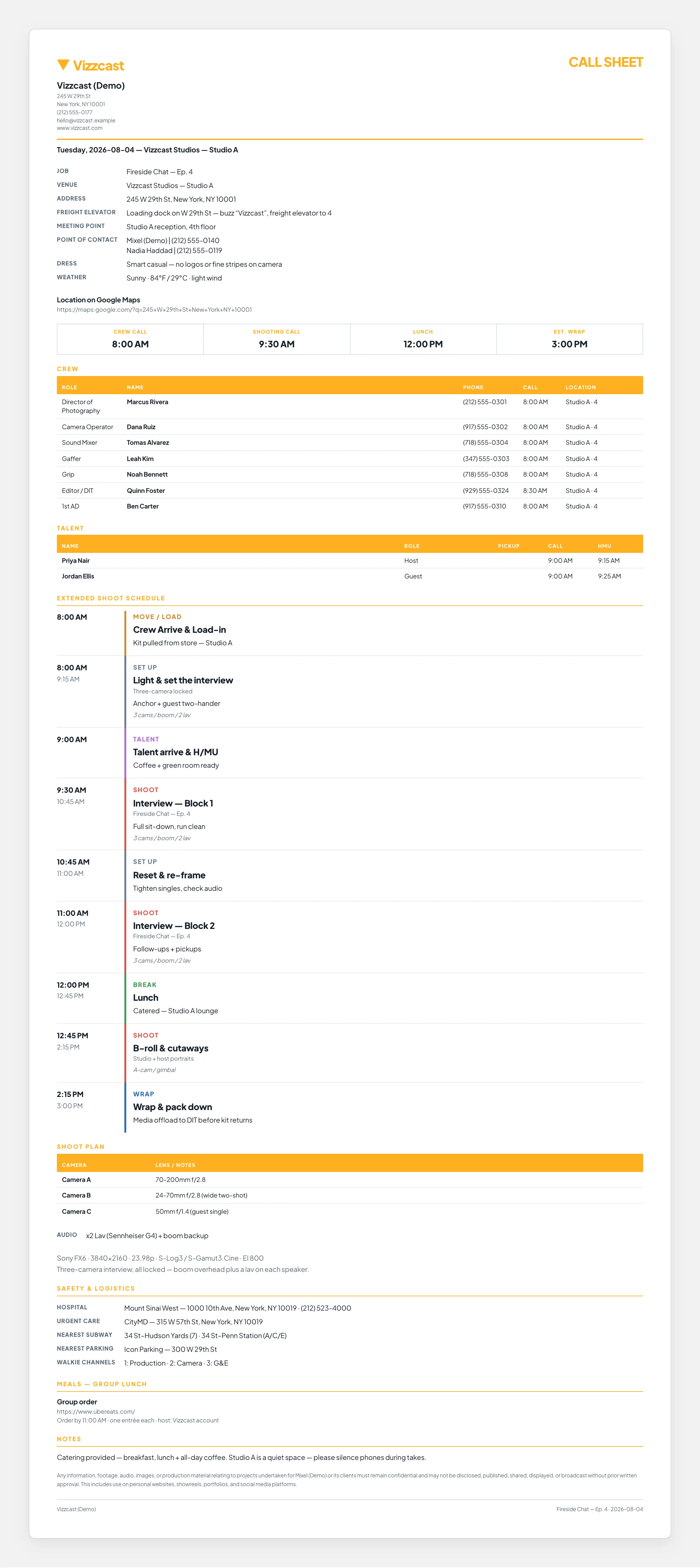
The PDF is attachedThe full call sheet, the same one you previewed, travels with every email.
Confirmed comes back to youThe tap lands on your status card as Confirmed with a time, per person, and the bar on their page turns into a Confirmed chip.
kitslate.app/p/… · on their phone
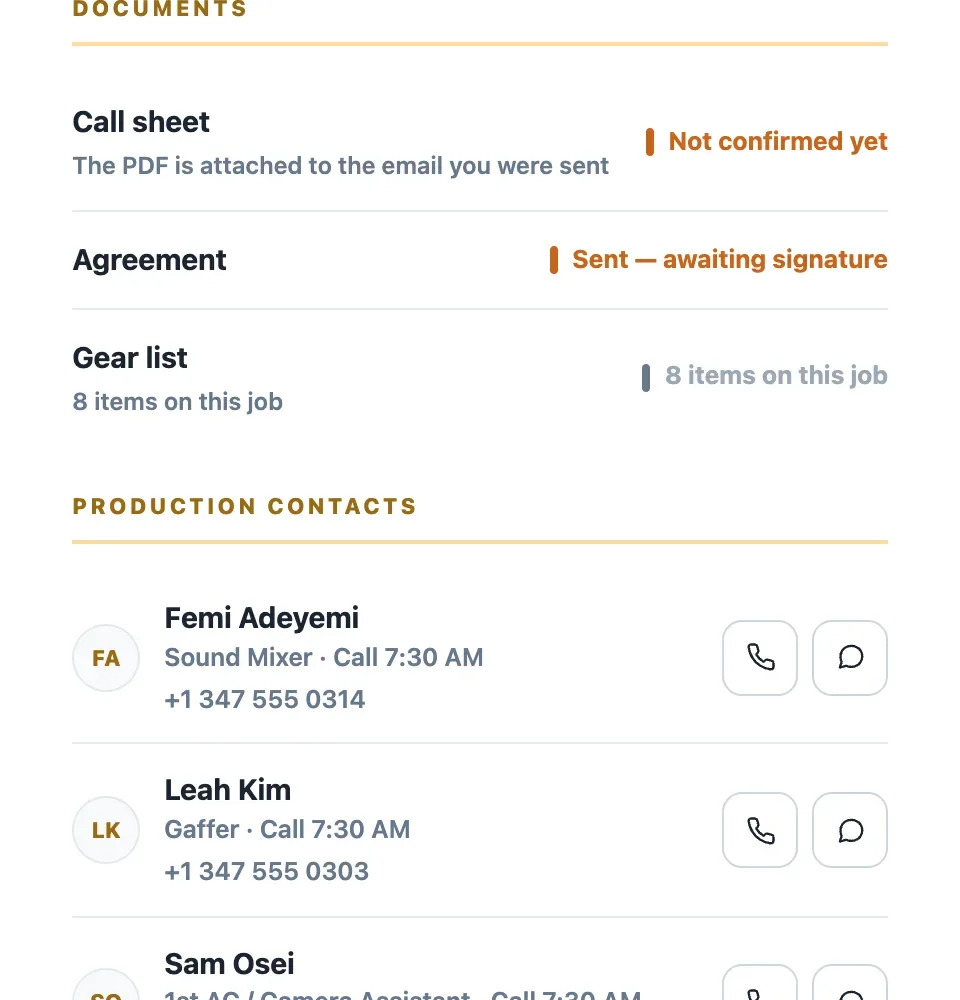
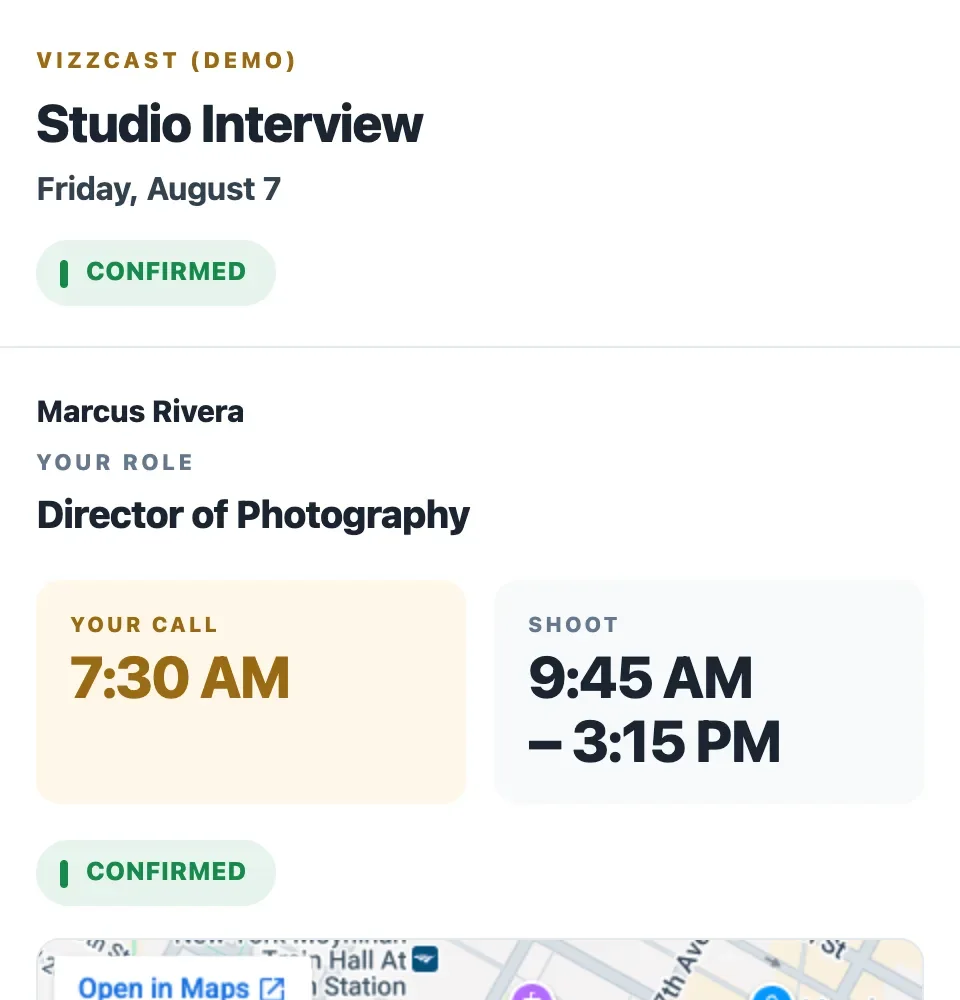
The crew member's page on a phone: the production and date, their role and call time, a Confirm you have this bar with a Confirm call sheet button, the map with an Open in Maps button and the address, an If anything changes card with Call and Text buttons, the Documents list, and the production contacts — screen 1 of 3
… scrolled
The crew member's page on a phone: the production and date, their role and call time, a Confirm you have this bar with a Confirm call sheet button, the map with an Open in Maps button and the address, an If anything changes card with Call and Text buttons, the Documents list, and the production contacts — screen 2 of 3
… scrolled
The crew member's page on a phone: the production and date, their role and call time, a Confirm you have this bar with a Confirm call sheet button, the map with an Open in Maps button and the address, an If anything changes card with Call and Text buttons, the Documents list, and the production contacts — screen 3 of 3
The page the email opens, top to bottom: their call, the confirm bar, the map, who to call, their documents.
kitslate.app/p/… · after the tap
The top of the crew member's page after tapping Confirm — the production, their role and call, and the confirm bar replaced in place by a CONFIRMED chip
After the tap: the bar becomes a Confirmed chip, and your status card shows the same.
kitslate.app/p/… · on a laptop
The same page on a laptop — the production and date, the recipient's role and call time, the location with a maps link, who to call if anything changes, and their documents
The same page on a laptop. One responsive page, not a separate mobile copy.
Call-sheet.pdf · attached to every email
The call sheet as a PDF: the production, date and venue across the top, the key times, the crew table with calls and locations, and the schedule
The PDF attached to each person's email. The same sheet you previewed in the editor.
02 · THE QUOTE — the number, the date it holds until, the PDF

A quote that reads in one glance.

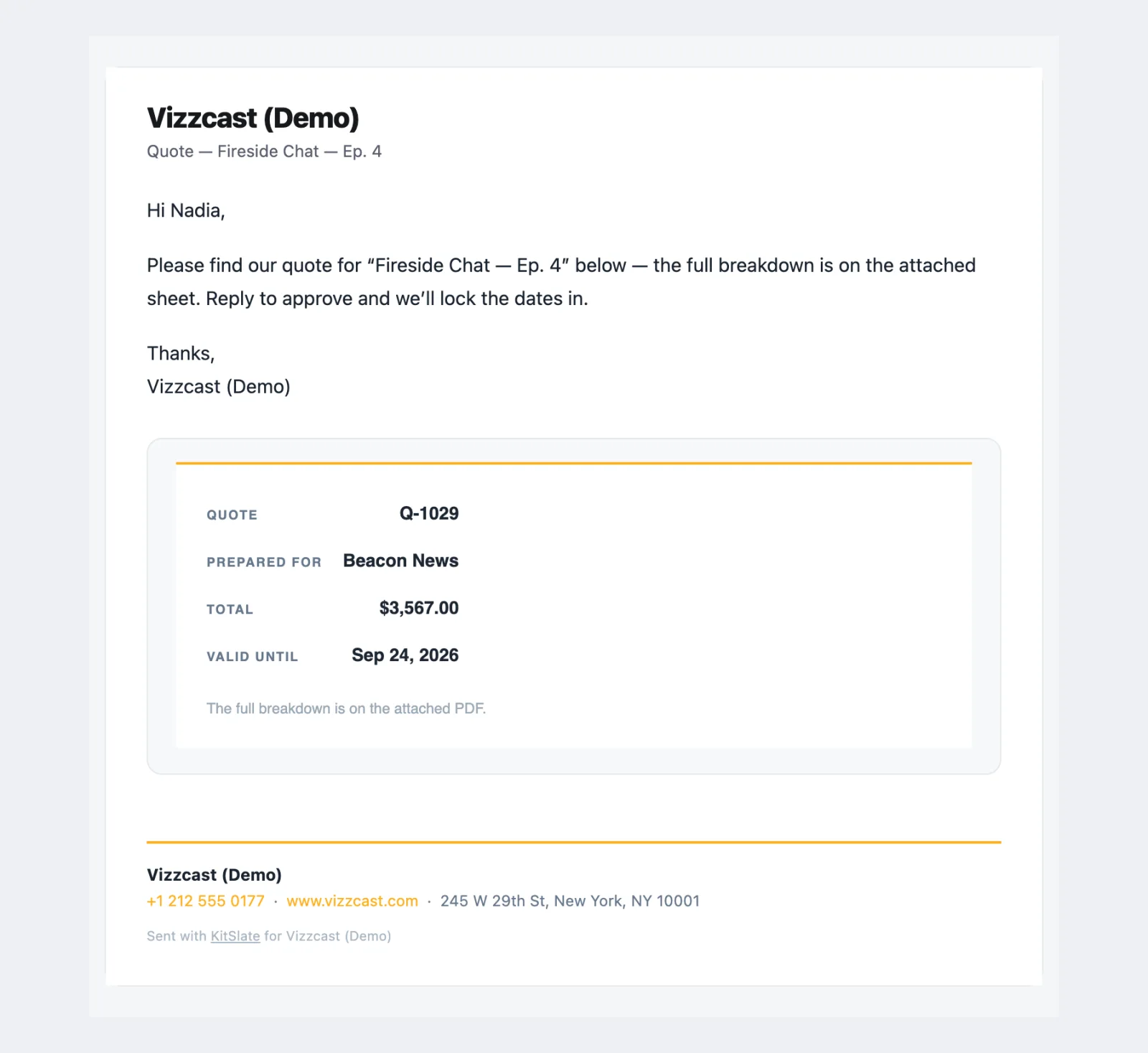
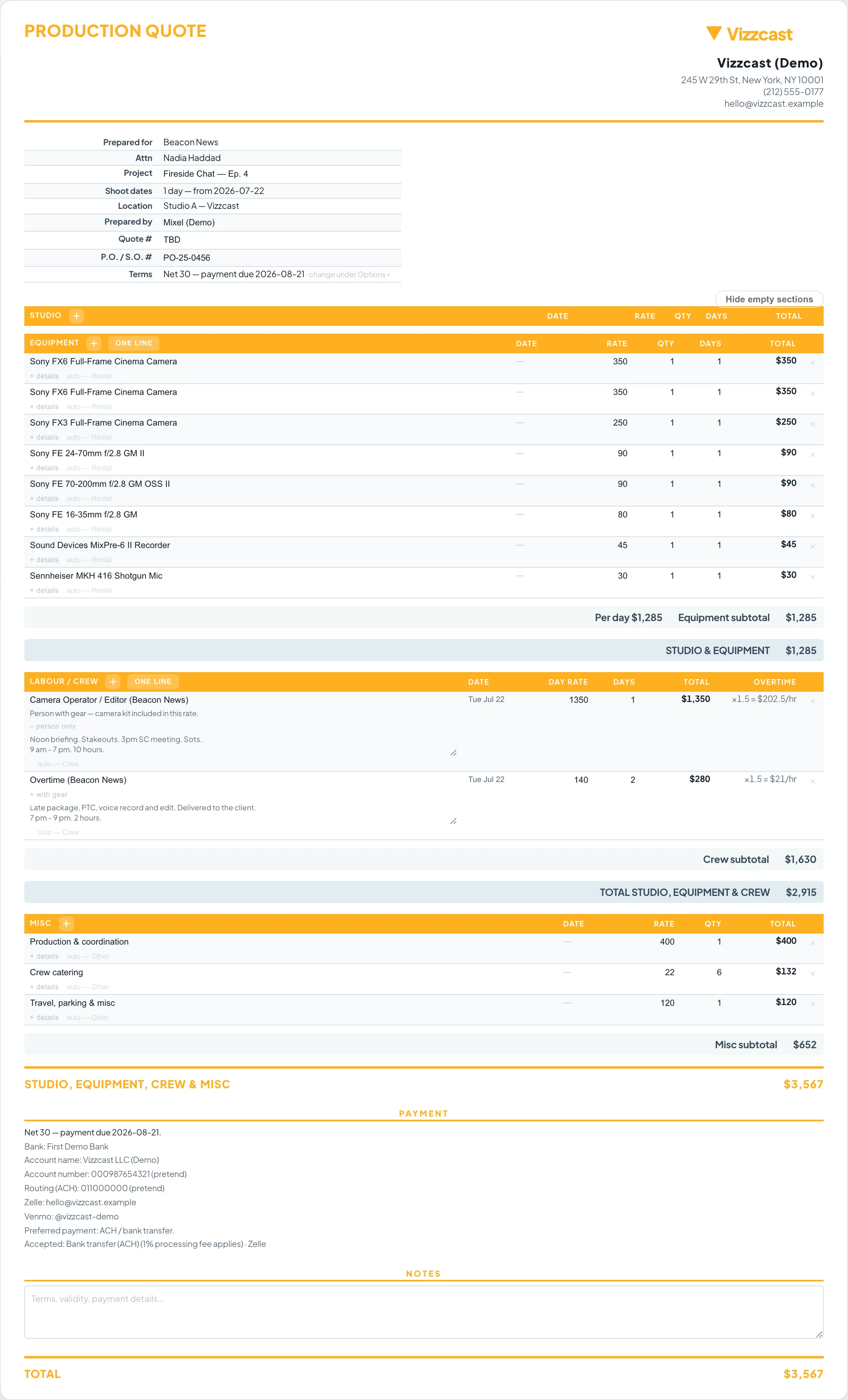
The email carries the quote number, who it is for, the total and how long it is valid, with your message above and your company’s details beneath. The sheet the client opens and the PDF carry the sections and their totals.
Your wordingThe greeting and the message are yours, saved per document type in the sending box, so every quote goes out the way you say it.
Approval comes backWhen the client approves, the quote’s status card shows it, and the invoice is raised from that approved quote with one click.
The footer is your companyPhone, website and address from the letterhead. The only mention of KitSlate is a small line at the bottom.
the client’s inbox · Quote — Fireside Chat — Ep. 4
The quote email: the company name and Quote — Fireside Chat — Ep. 4, a greeting by first name and the message, then a card with the quote number, who it is prepared for, the total and the valid-until date, a note that the full breakdown is on the attached PDF, and the company's details in the footer
The quote email. The number, the client, the total and the valid-until date.
the client’s browser · the quote
The quote as the client receives it: letterhead, the sections and their totals on one page
The quote as the client opens it: letterhead, sections, totals.
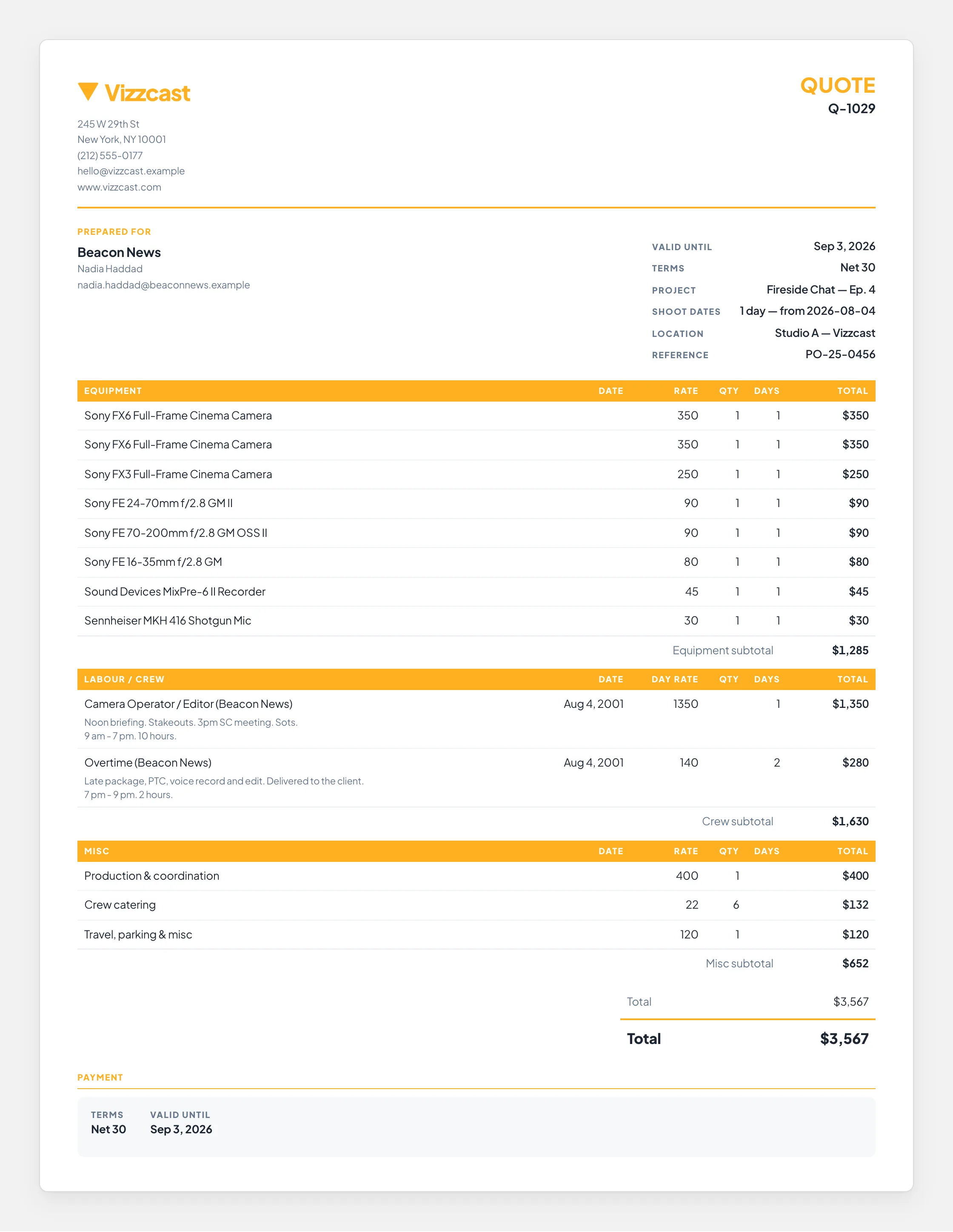
Quote.pdf
The quote as a PDF, printed from the same document
The PDF, printed from the same document.
03 · THE EQUIPMENT LIST — what is coming on the day

The gear, category by category.

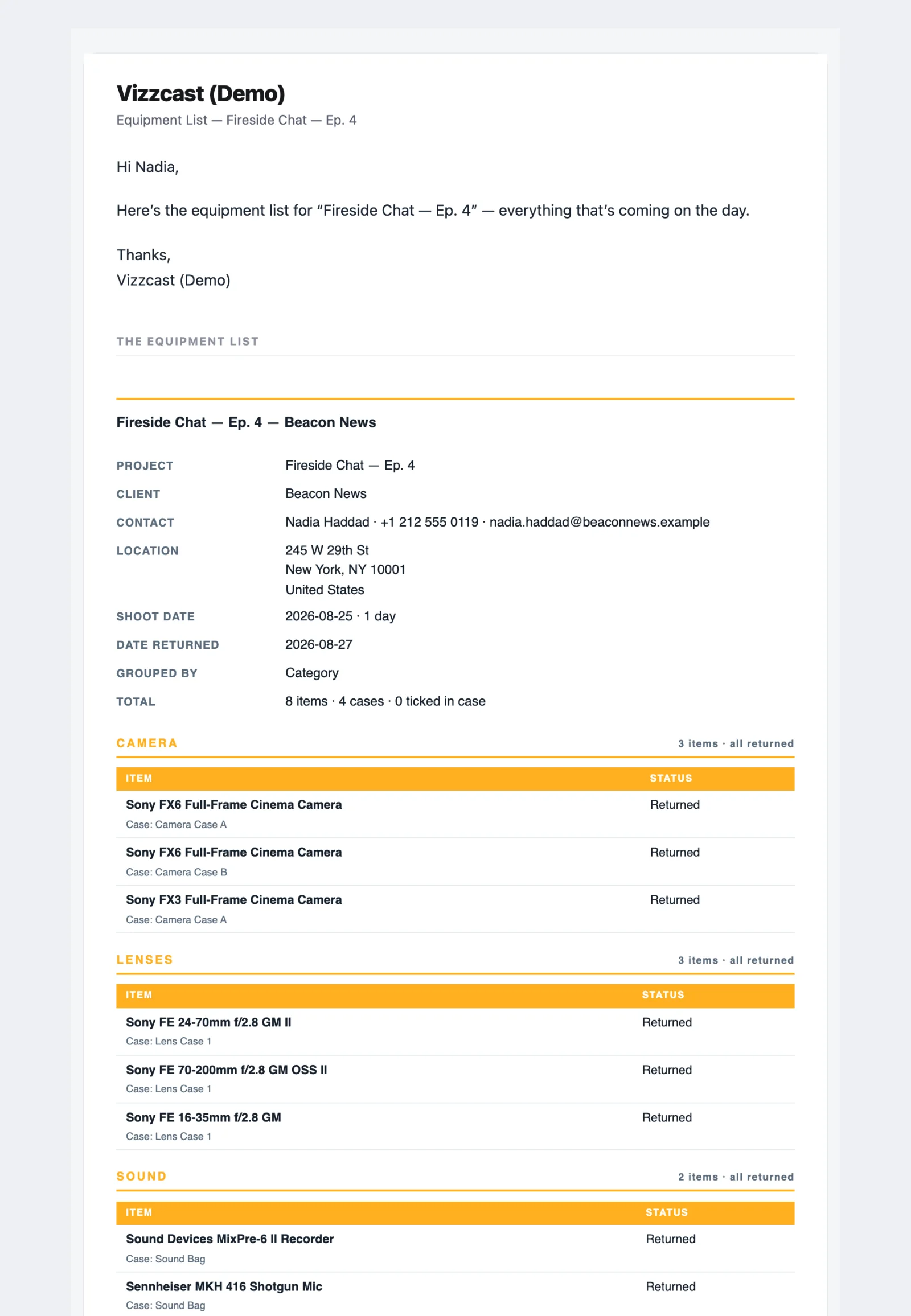
The equipment list goes to a client, a supplier or a crew member with the project, the contact, the location and the dates at the top, then every category with its items and their status, only the columns you left switched on.
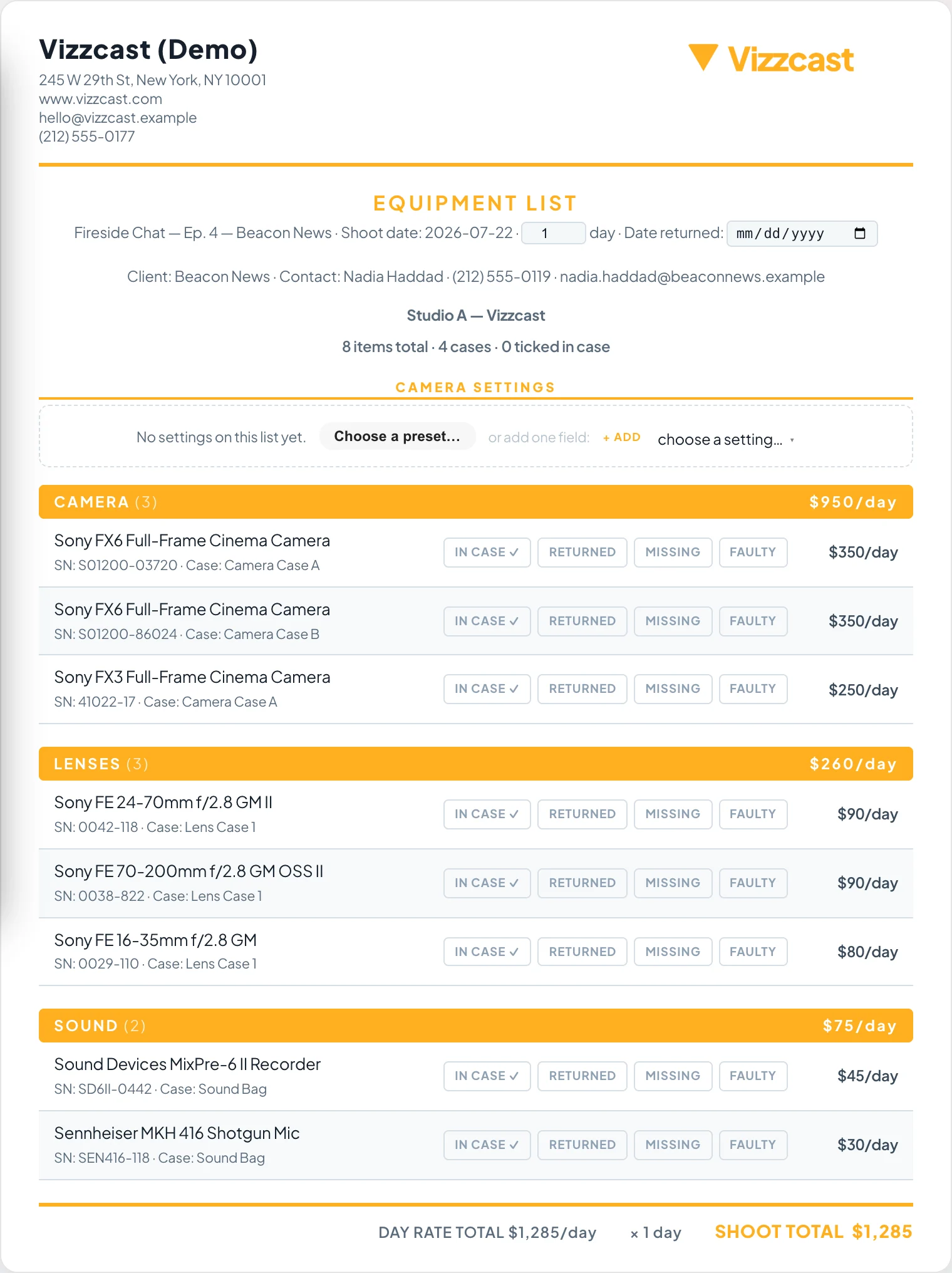
Serials stay insideSerial numbers and rates are for you; the list that goes out carries what a reader on the day needs.
Returned, missing, faultyEach row’s packing state prints, so a returns list reads off the same document.
the client’s inbox · Equipment List — Fireside Chat — Ep. 4
The equipment list email: the company name and Equipment List — Fireside Chat — Ep. 4, a greeting and the message, then the list itself with project, client, contact, location, shoot date, date returned, grouping and totals, and the categories with their items and status
The equipment list email, with the whole list in it.
Equipment-list.pdf
The equipment list as it is sent: the categories and rows on one page
The PDF: only the columns left switched on.
04 · THE AGREEMENT — read and signed on a phone

The release, a place to sign, a copy to keep.

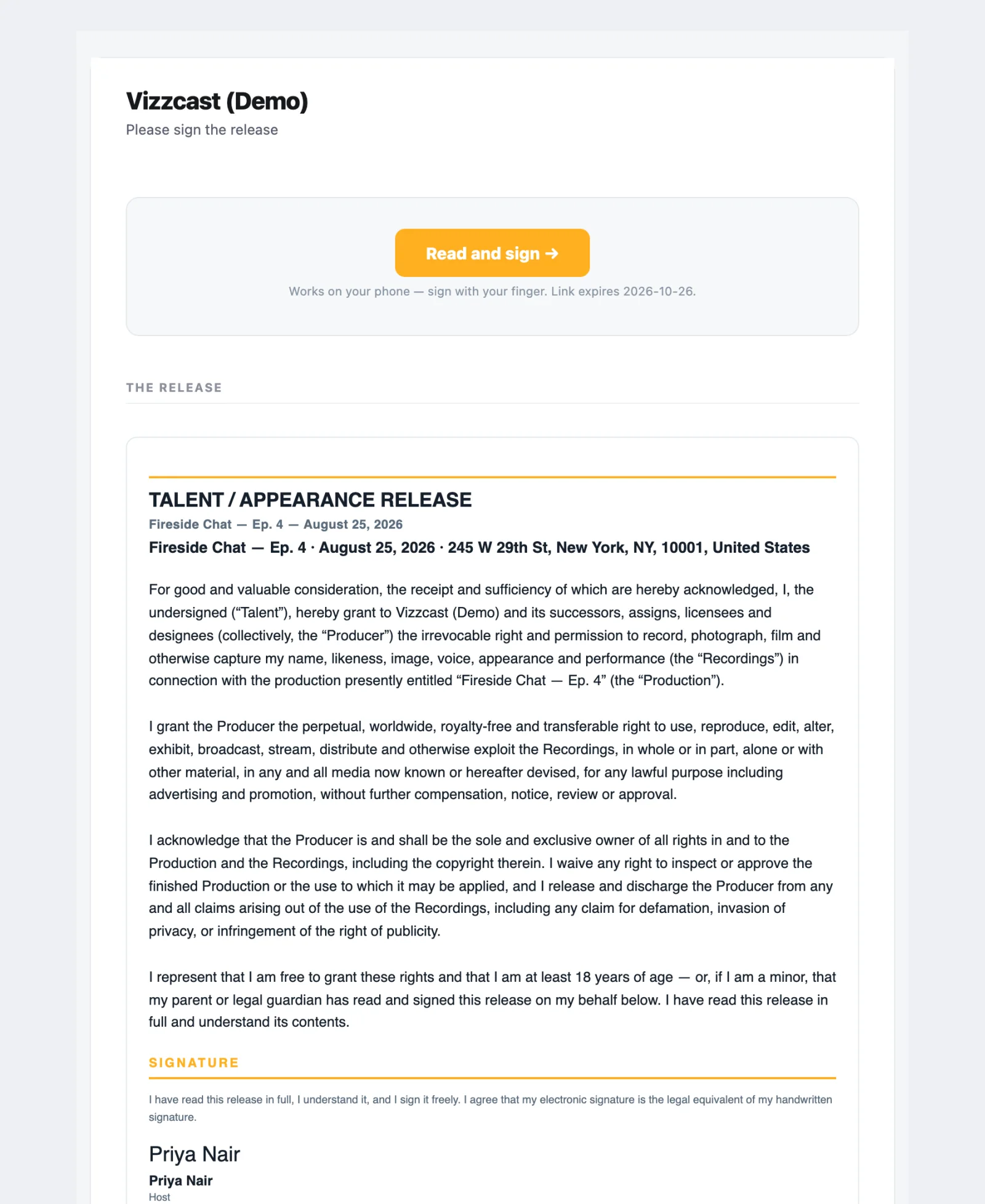
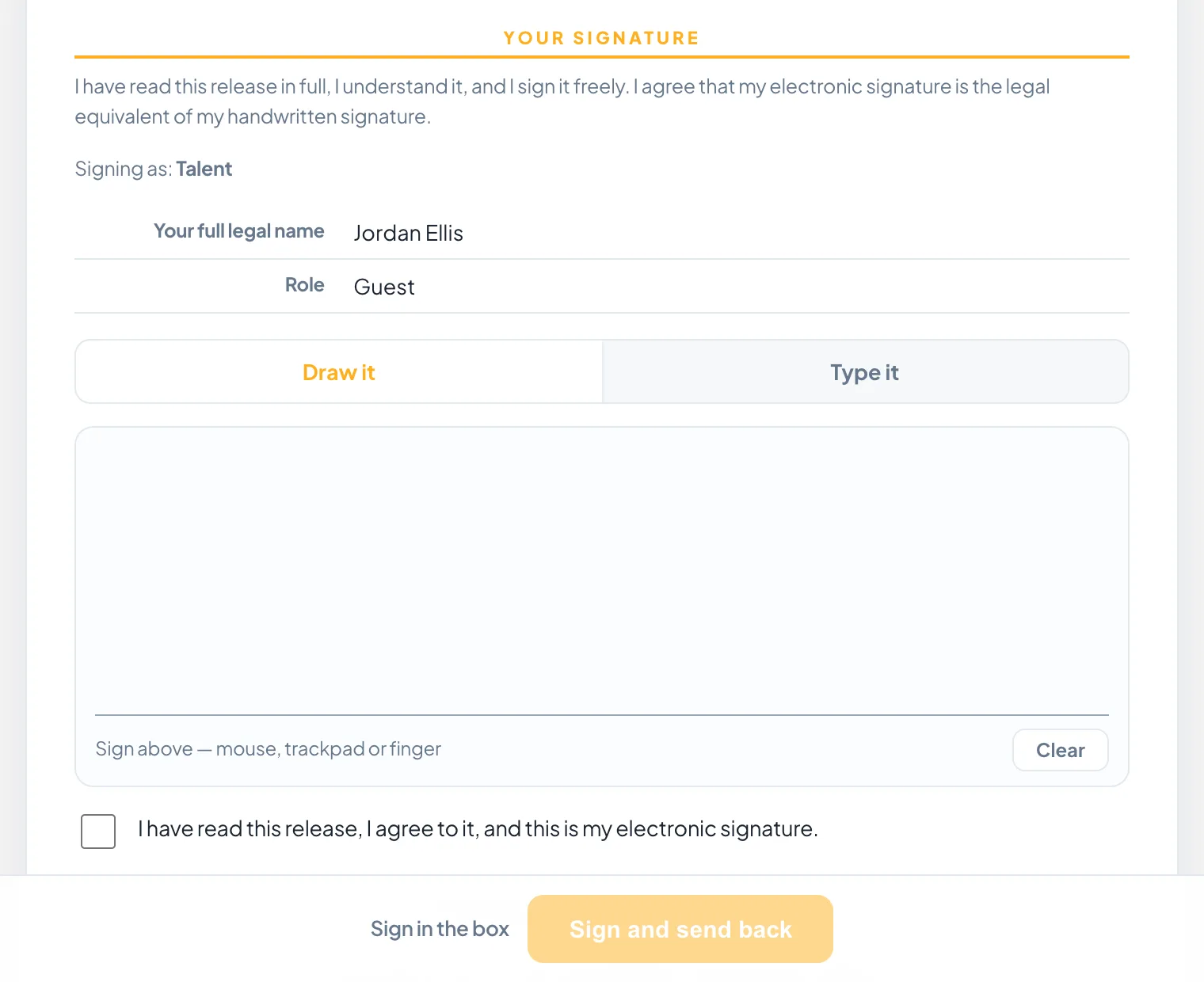
The email says what it is and carries the whole release beneath a Read and sign button. The button opens the signing page: the consent statement, who they are signing as, a draw-or-type signature pad, and Agree. A nudge goes out with one click if they have not.
One private link per signerEach person gets their own link and signs only their own part. The link has an expiry, printed in the email.
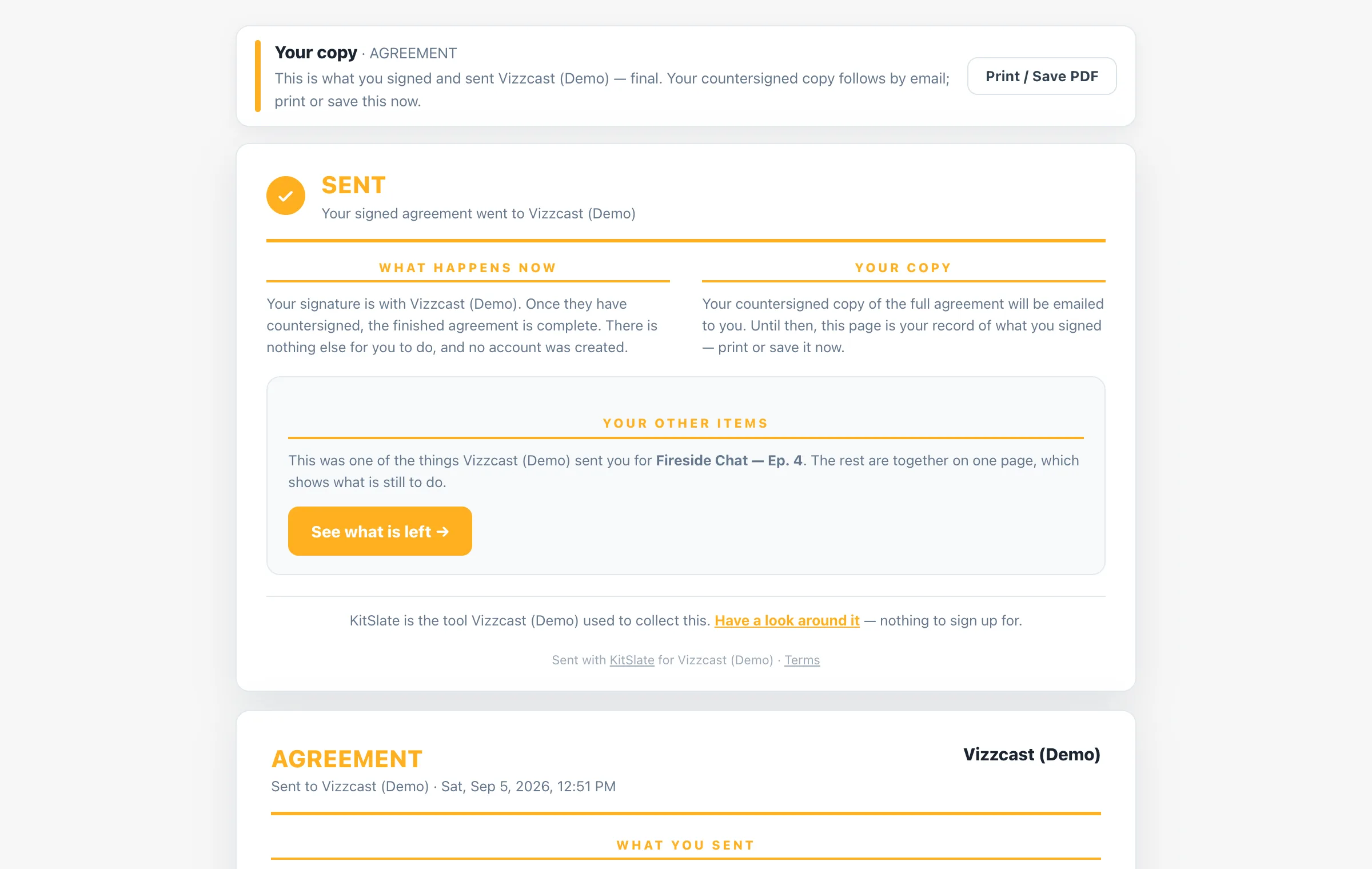
They keep a copyAfter signing, the page becomes their receipt with a Print / Save PDF button, and the signed copy is emailed to them by the system at the moment of signing.
Sent, viewed, signedEach state comes back to the agreement’s status card with a time, name by name.
Kept exactly as signedThe PDF you file is the text they saw, with their signature, not a re-render.
the signer’s inbox · Please sign the release
The release email: the company name and Please sign the release, a Read and sign button with a note that it works on a phone and when the link expires, then the full talent / appearance release text beneath a THE RELEASE heading
The agreement email. The button first, the whole release beneath it.
kitslate.app/sign · one private link per signer
The signing page a recipient opens — the consent statement, who they are signing as, their name and role, a draw-or-type signature pad and the agree button
The signing page, on a phone: the statement, the pad, Agree.
kitslate.app/sign · after signing
A signer's receipt after submitting an agreement: a Your copy banner with a Print / Save PDF button, a SENT card with What happens now and Your copy, and the signed release beneath
What the signer sees the moment they submit: their copy, and what happens next.
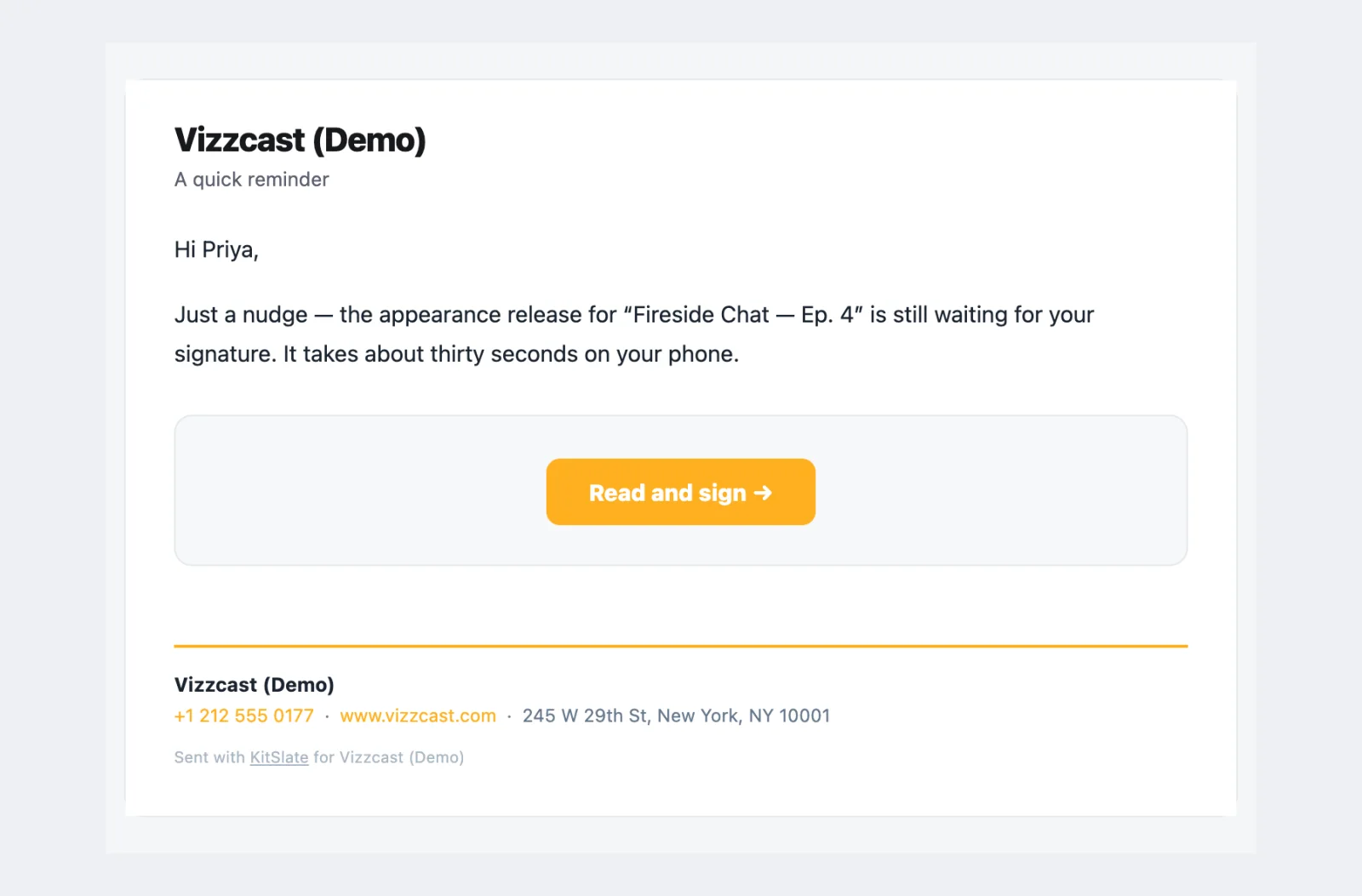
the signer’s inbox · Reminder — release for “Fireside Chat — Ep. 4”
The reminder email: the company name and A quick reminder, a greeting, a line saying the appearance release is still waiting for their signature and takes about thirty seconds on a phone, and a Read and sign button
The nudge. One click on the status card sends it; the same link, the same page.
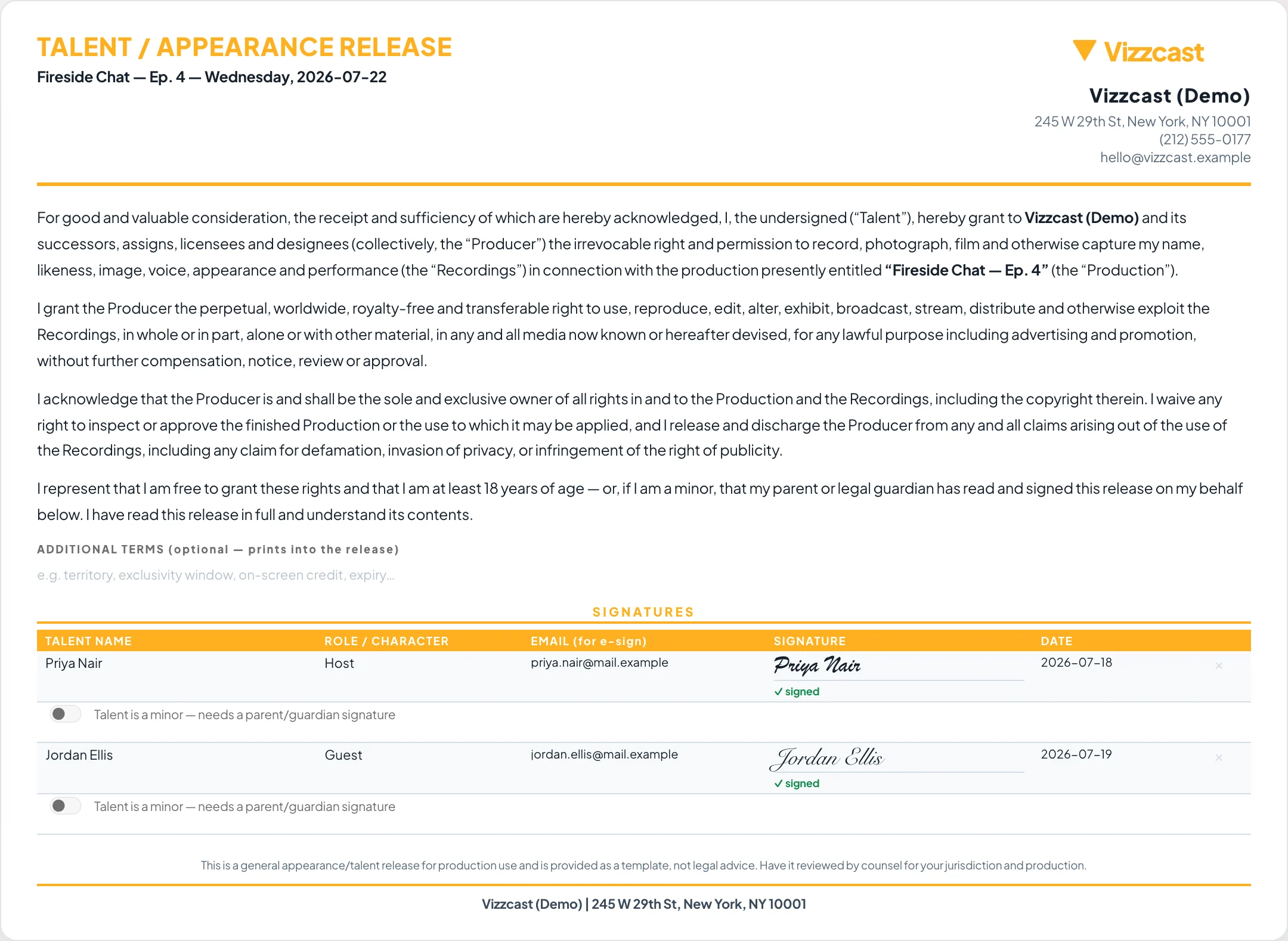
Release.pdf · as signed
The signed release as a PDF, kept exactly as it was signed
The PDF you file: the text they saw, with their signature.
05 · THE INVOICE — who owes what, by when, and where to pay

An invoice with a real Pay button.

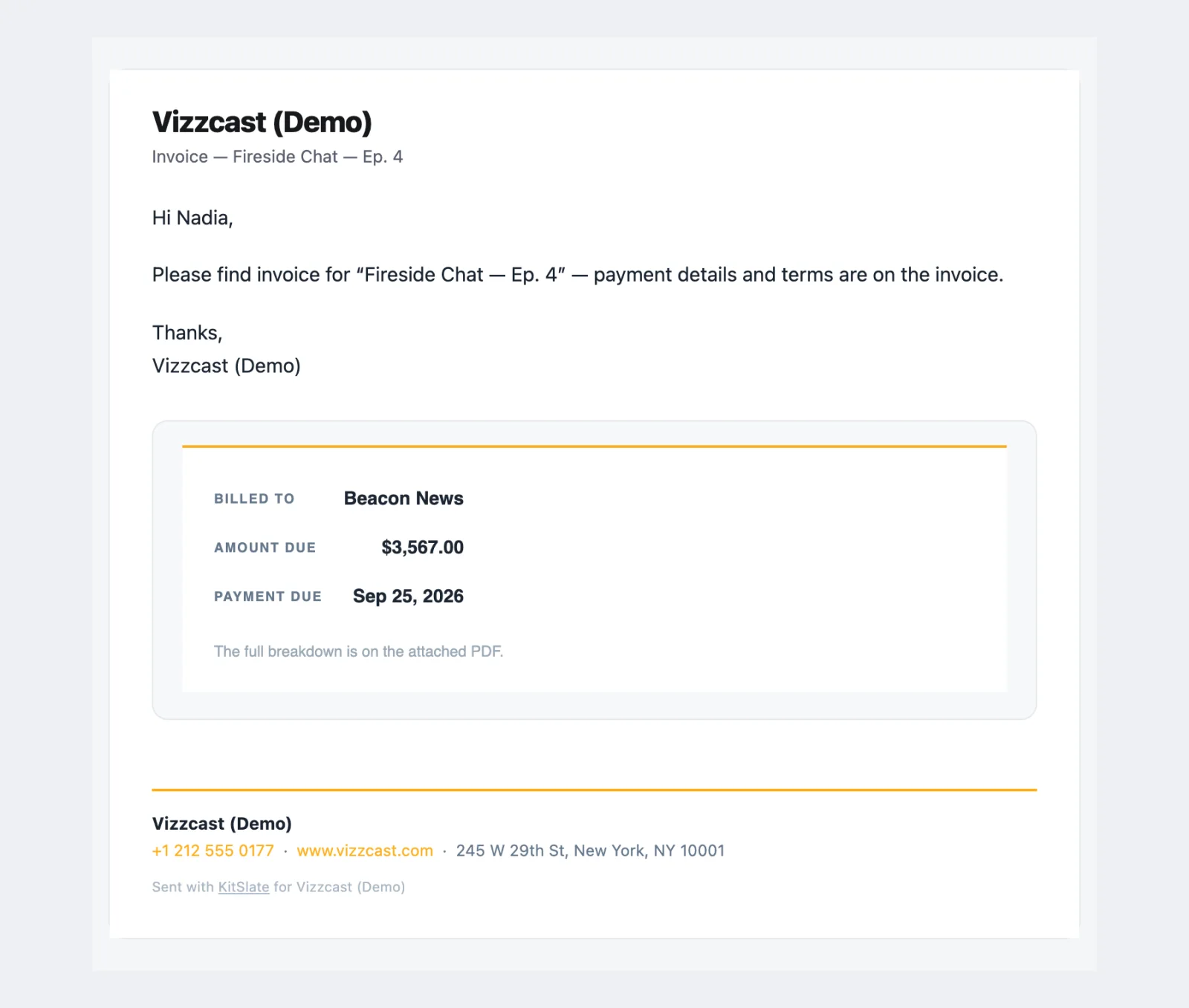
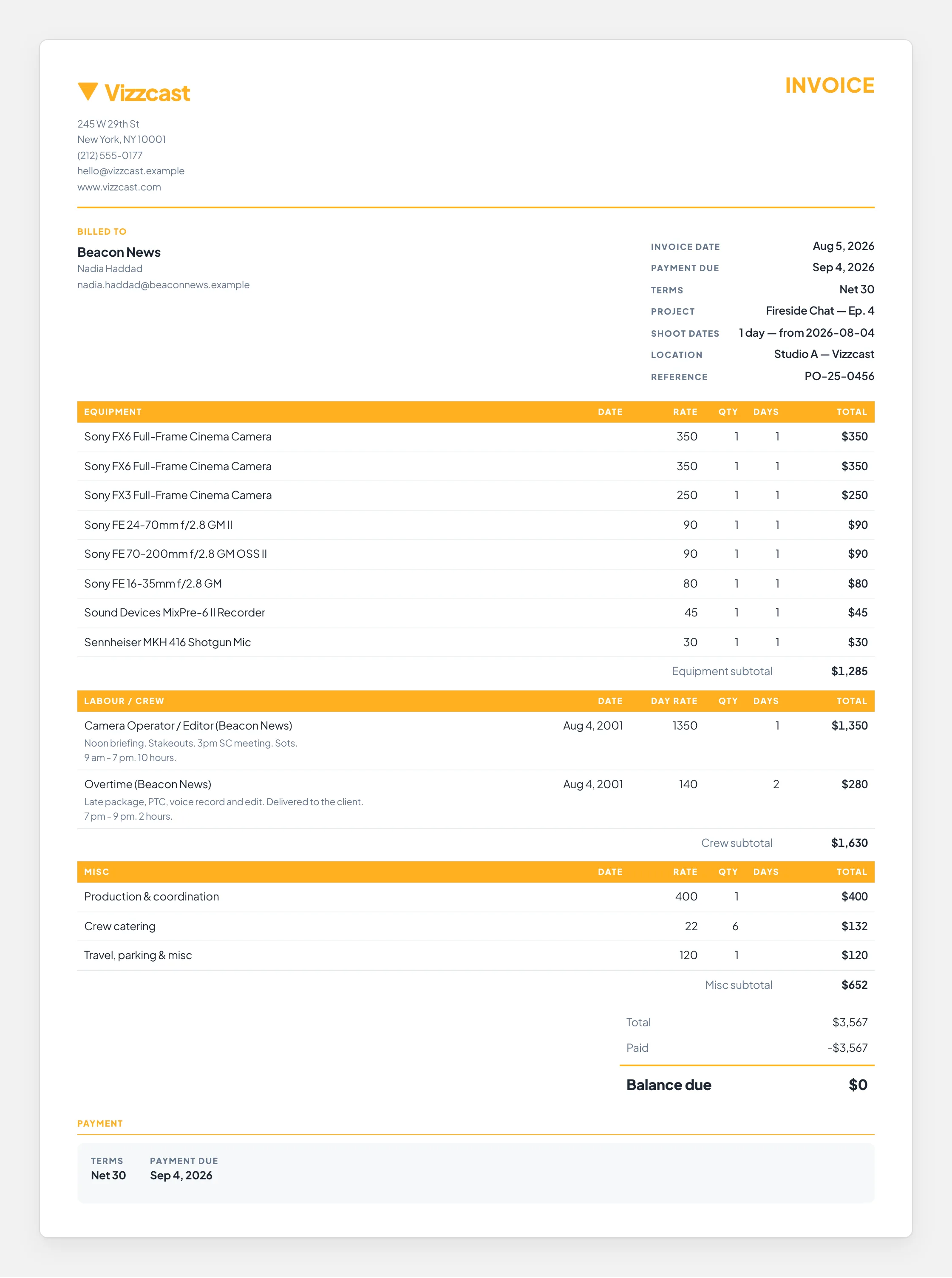
The email carries who it is billed to, the amount due and the payment date, with the PDF attached. The hosted invoice it links to shows the same sections and totals and, with Stripe connected, a Pay button that takes the card there and then.
Paid comes backA card payment marks the invoice paid on your side without you touching it; a bank transfer is recorded when it lands.
Receipts to the crewCrew receipts can ride on the same send, so the person who fronted the taxi gets paid back from the same invoice.
Revisions keep their historyEdit a published invoice and the client sees the current version; every earlier version stays on file.
the client’s inbox · Invoice — Fireside Chat — Ep. 4
The invoice email: the company name and Invoice — Fireside Chat — Ep. 4, a greeting and the message, then a card with who it is billed to, the amount due and the payment due date, a note that the full breakdown is on the attached PDF, and the company's details in the footer
The invoice email. Billed to, amount due, payment due.
kitslate.app/invoice/… · the client pays here
The hosted invoice the client opens: a numbered, dated invoice carrying the same lines and the payment terms, with a Pay button
The hosted invoice: the same sections and totals, and the Pay button.
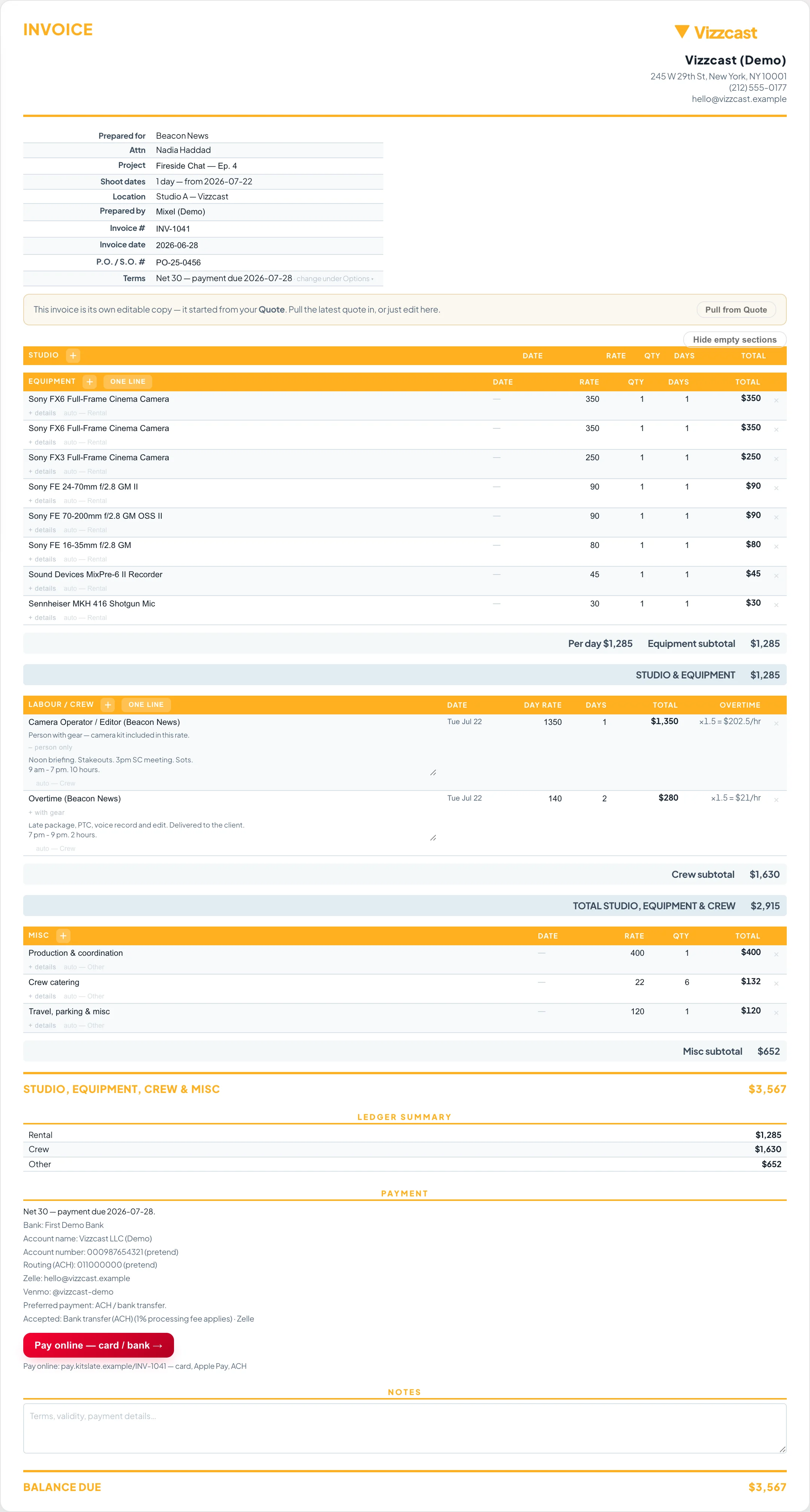
Invoice.pdf
The invoice as a PDF: the same sections and the same totals
The PDF attached to the email.
06 · SEVERAL AT ONCE — one email, one page, every document

When one person owes you three things.

A client who has a quote to review, a release to sign and an invoice to pay gets one email listing them, and one page that walks through them in order. Each row shows done when it is done.
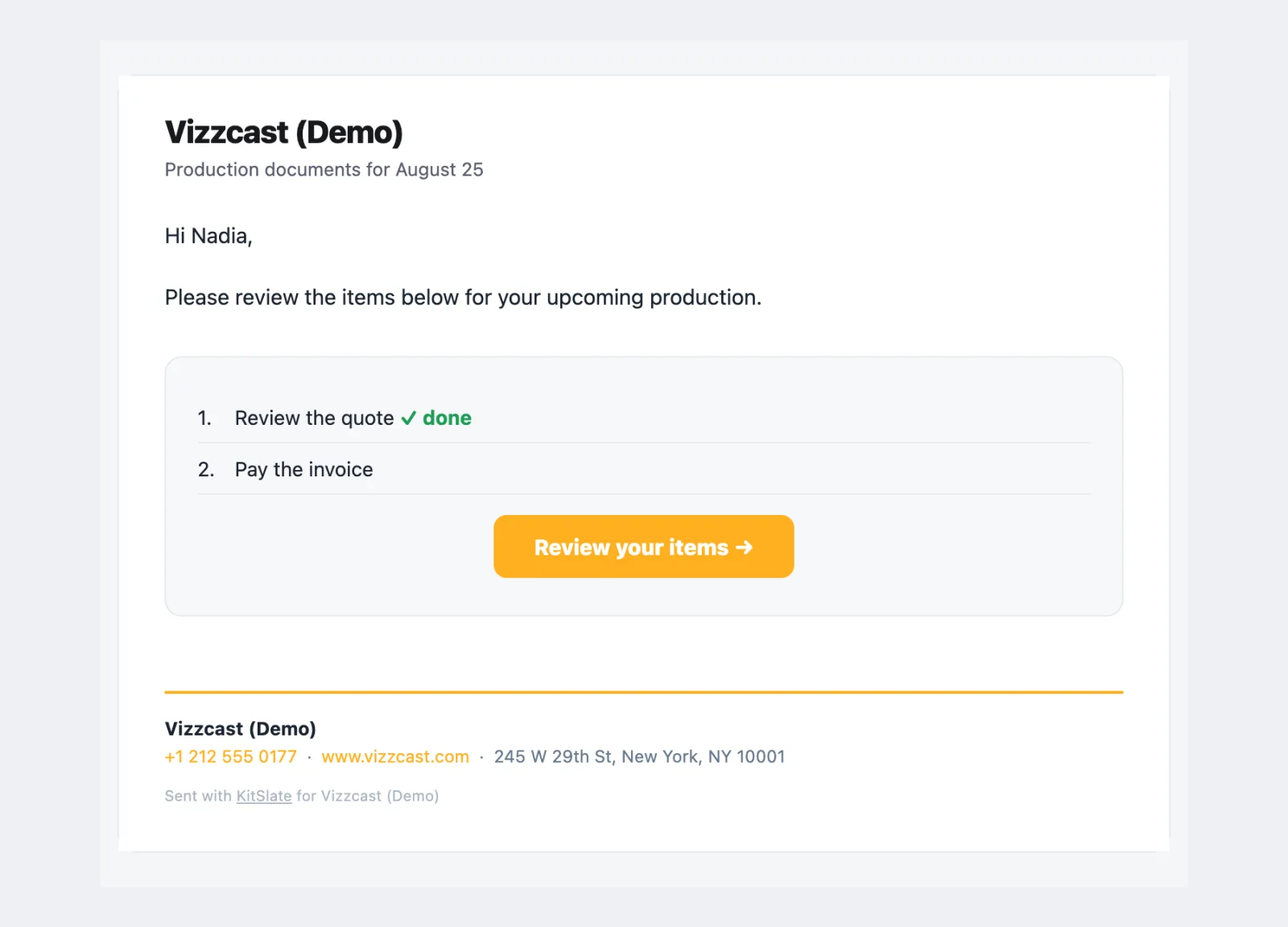
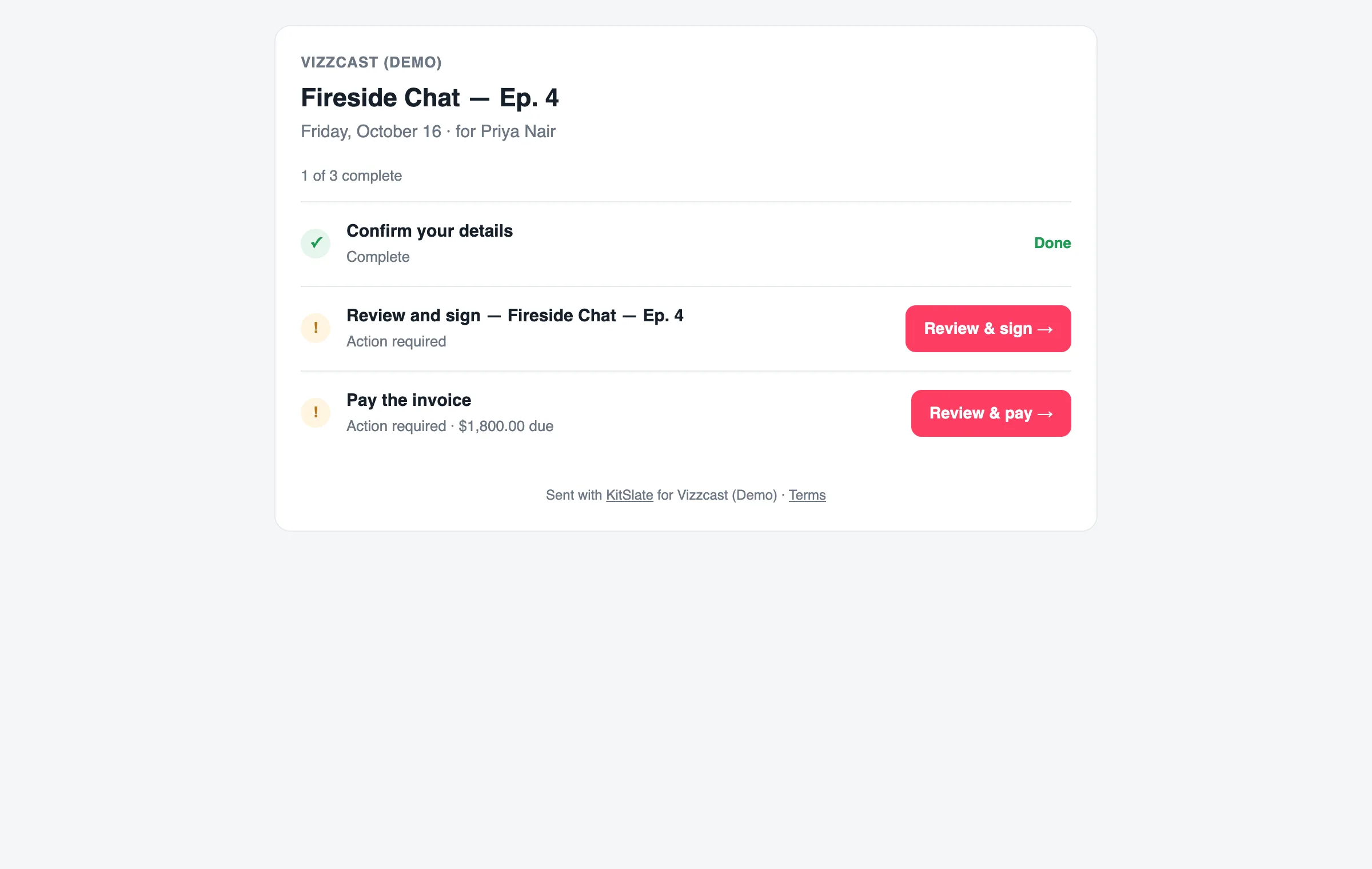
One link, not threeThe Review your items button opens a page that says 1 of 3 complete and shows each item with its own button: review, sign, pay.
Done stays doneAnything already handled shows a green done in the email and on the page, so a second send never asks twice.
Their details, firstIf you need their address or bank details, that request is the first row, and what they enter fills your records.
the client’s inbox · Production documents for August 25
The batch email: the company name and Production documents for August 25, a greeting, then a numbered list — Review the quote marked done in green, Pay the invoice — and a Review your items button, with the company's details in the footer
One email for everything outstanding. The quote is already done; the invoice is next.
kitslate.app/b/… · the client’s page
The recipient's page: the production and date, 1 of 3 complete, then three rows — confirm your details marked Done, review and sign with a Review & sign button, and pay the invoice
The page it opens: 1 of 3 complete, each item with its own button.
07 · ASKING FOR THINGS — their details, their receipts, their part of the work

When you need something from them.

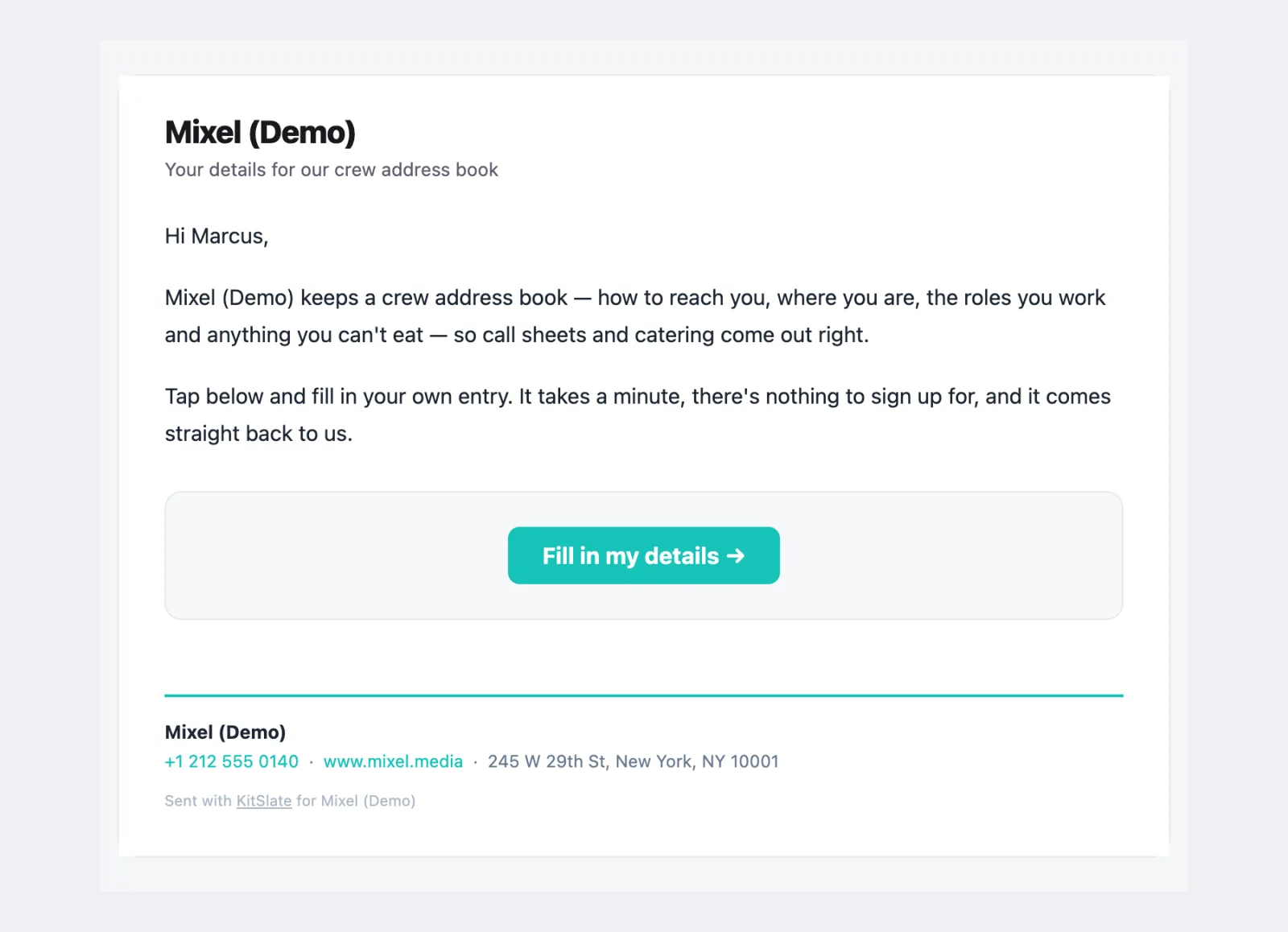
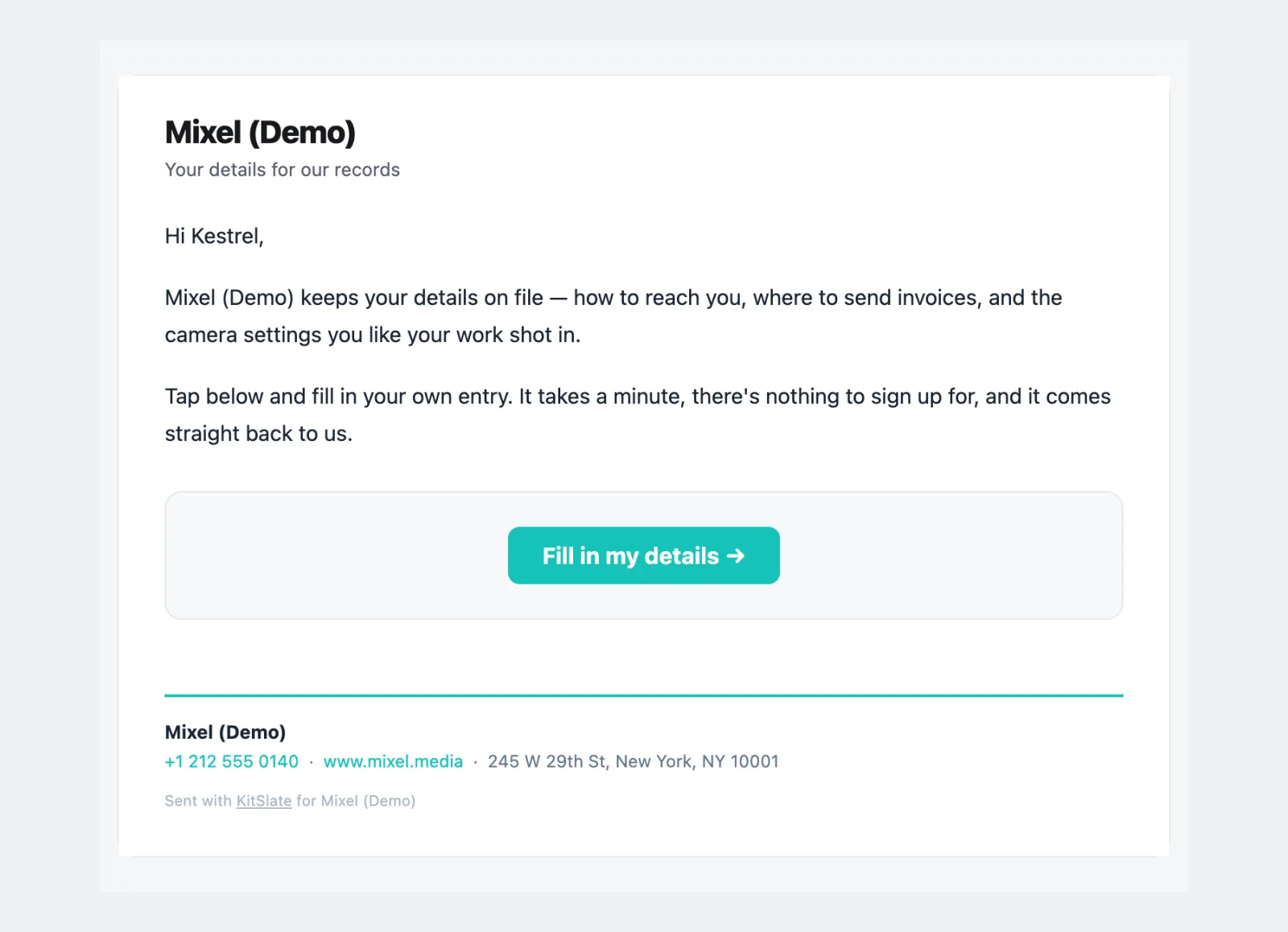
Three emails ask rather than tell: a crew member for their own entry in your address book, a client for their billing details and camera preferences, and anyone on the job for the receipts they paid for. A fourth hands a document to someone to fill in.
Nothing to sign up forEach opens a private form on a phone; what they enter comes straight back into your records.
Receipts by replyThe receipts email carries an address to forward an Uber, a Lyft or a card receipt to, and a link to photograph one. The link stays open for the whole job.
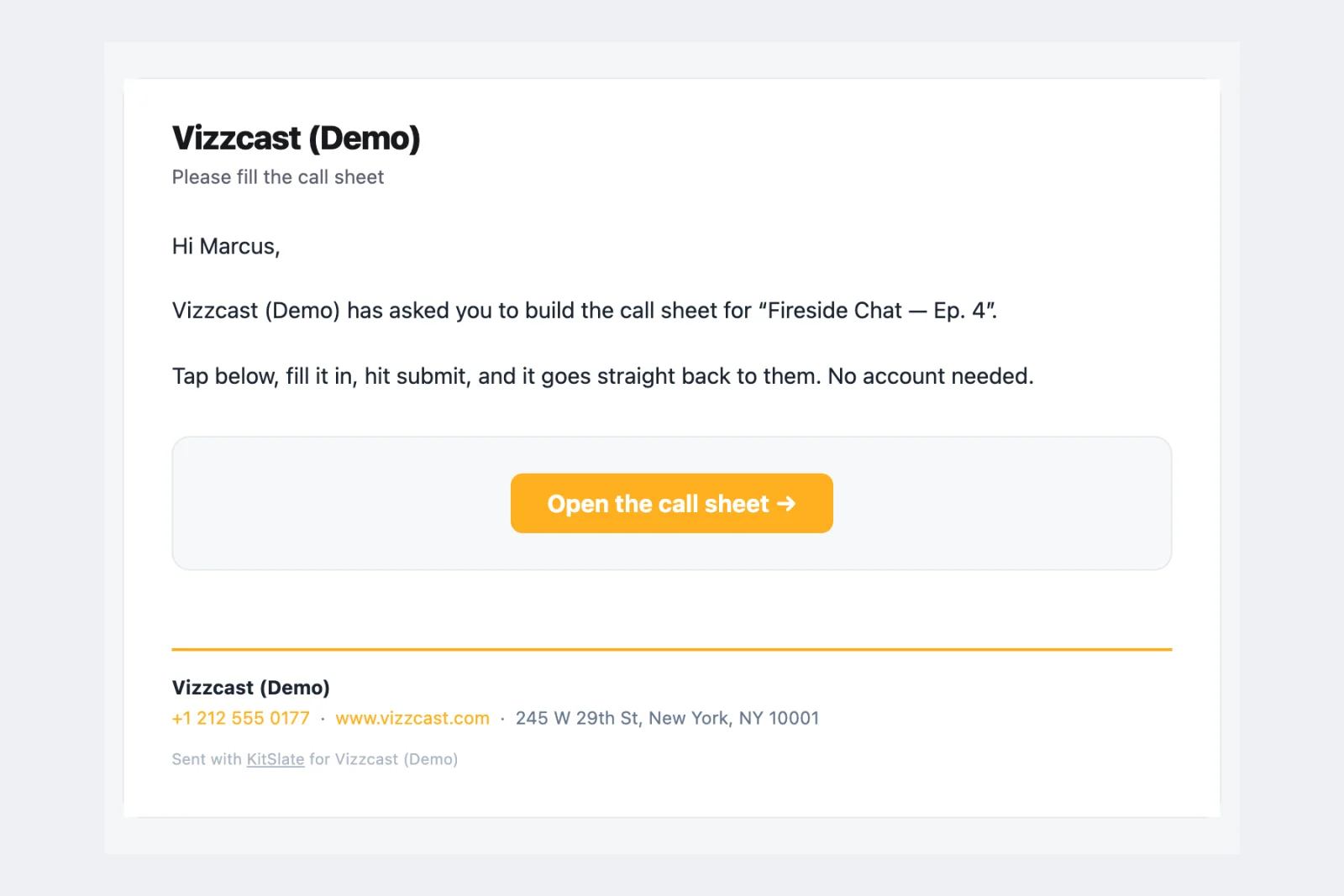
Hand over a documentAsk a coordinator to build the call sheet: they get the form, fill it in, submit, and it lands in your production.
the crew member’s inbox · Your details for our crew address book
The crew request email: the company name and Your details for our crew address book, a greeting, two short paragraphs explaining why and that it takes a minute with nothing to sign up for, and a Fill in my details button
Asking a crew member for their own entry.
the client’s inbox · Your details for our records
The client request email: the company name and Your details for our records, a greeting, a paragraph about how to reach them, where to send invoices and the camera settings they like, and a Fill in my details button
Asking a client for billing details and camera preferences.
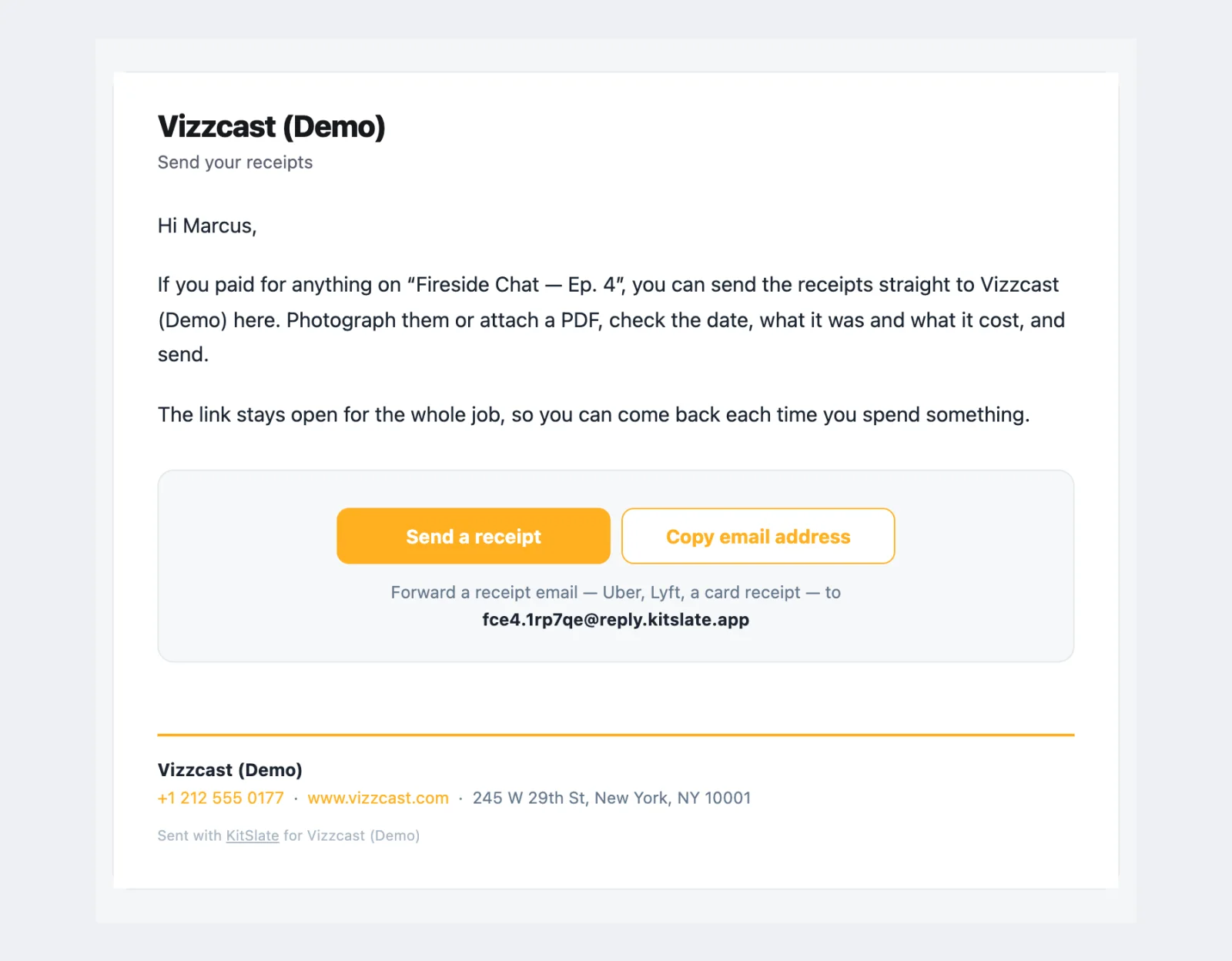
the crew member’s inbox · Send your receipts
The receipts email: the company name and Send your receipts, a greeting, two paragraphs explaining that receipts for the job can be sent here and the link stays open, a Send a receipt button, a Copy email address button and the reply address to forward receipts to
Asking for receipts: a button to photograph one, and an address to forward one to.
the coordinator’s inbox · Please fill the call sheet
The hand-off email: the company name and Please fill the call sheet, a greeting, a line saying the company has asked them to build the call sheet for the job, a note that no account is needed, and an Open the call sheet button
Handing a document to someone to fill in. No account needed.
08 · WHAT COMES BACK TO YOU — the status cards, and the emails you receive

A receipt for them, a status for you.

Every action leaves the person with something to keep and you with a state you can see. Sent, opened, confirmed, viewed, signed and paid come back to the document’s status card with a name and a time. Two things reach you by email: an enquiry from your public page, and a message about something you are selling.
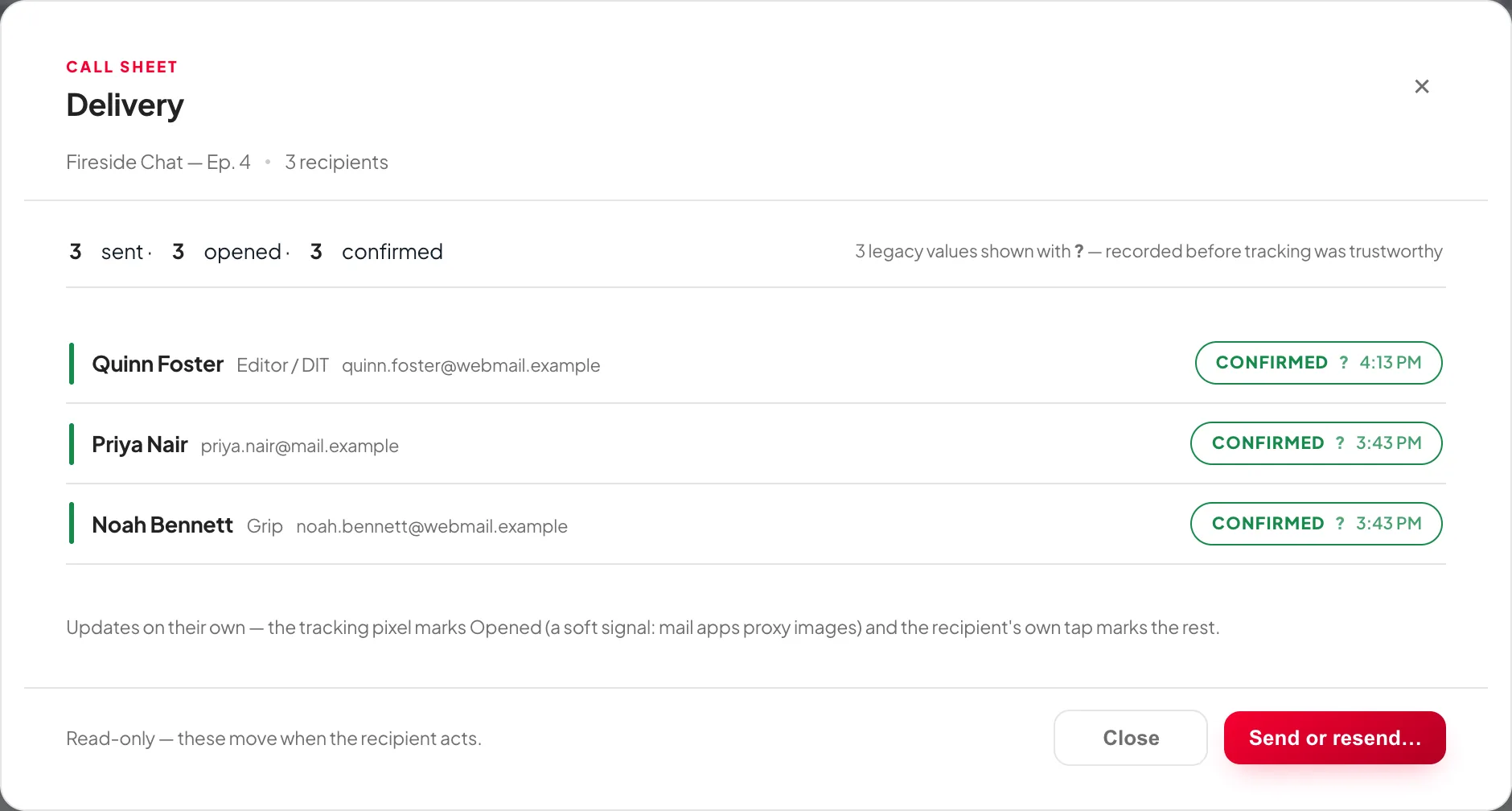
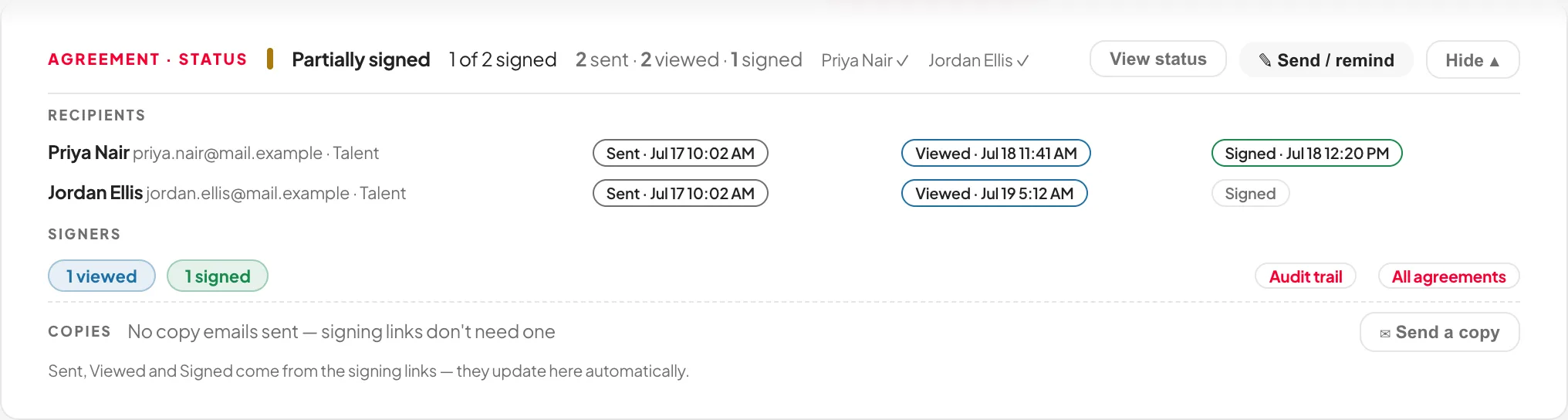
Per person, with timesThe call sheet card tracks each person through Sent, Opened and Confirmed; the agreement card through Sent, Viewed and Signed.
Nothing needs an accountCrew, clients and signers never sign up for anything. A private link is the whole login.
A cancelled link says soIf you revoke or resend, the old link shows a plain notice naming who sent it and what it was, never a dead page.
app.kitslate.app · call sheet · status
The call sheet status card open — each crew member's row showing sent, opened and confirmed with times
The call sheet's status card: who has confirmed, with times.
app.kitslate.app · agreements · status
The agreements tab: who has signed, name by name, and who is still to sign
The agreement's status card: sent, viewed, signed, name by name.
QUESTIONS — the ones people ask first

Before you try it.

Do my crew or clients need a KitSlate account?

No. Everything they receive works from a private link in the email. Nothing to install, nothing to sign up for.

Who does the email come from?

Your company, with its name, colour and details from the letterhead. Replies come back to you. KitSlate appears once, as a small line at the foot. Only the account emails at the top of this page come from KitSlate itself.

Can I see it before I send?

Yes. Every sending box has a Preview that shows the exact email per recipient, and every document has a View as they see it link on its status card afterwards.

Are these real captures?

Yes. They are taken from the sandbox workspace, built by the same code and templates that send real email. Open the sandbox and send one yourself to see it live.

Send one and see for yourself.

The sandbox has a production with crew, a client and every document already on it. Press Send and read what arrives.